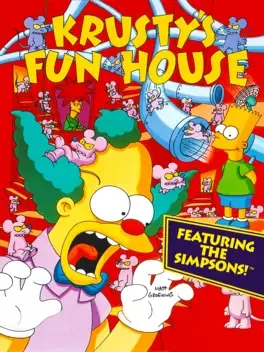
Krusty's Fun House
Introduction
In the early 1990s, The Simpsons was a global phenomenon, and video game developers were eager to capitalize on the show's massive popularity. While many early titles focused on Bart’s rebellious antics, Krusty's Fun House—also known in some regions and versions as Krusty's Super Fun House—took a refreshingly different approach. Instead of a traditional action-platformer, players were treated to a clever, brain-teasing puzzle game that highlighted Springfield's favorite cynical clown. This title stood out among its peers for its focus on logic and environment manipulation, proving that a licensed game could offer deep, rewarding gameplay beyond simple combat and mascot recognition.
Story & Setting
The premise is as simple as it is chaotic: Krusty the Clown's beloved Fun House has been completely overrun by a massive infestation of rats. These pesky rodents are scurrying through every corner of the building, threatening to shut down Krusty’s business and ruin his reputation. To save his empire, Krusty must venture through various themed sections of the Fun House, which are filled with bizarre contraptions, dangerous traps, and colorful obstacles. The setting perfectly captures the wacky, slightly off-kilter aesthetic of the Krustylu Studios seen in the animated series, providing a vibrant and humorous backdrop for the rodent-exterminating puzzles that follow.
Gameplay
The core gameplay of Krusty's Fun House is heavily inspired by the "lemmings" style of puzzle-solving. Players control Krusty directly, but your goal isn't just to reach an exit; instead, you must herd a group of mindless rats toward a specialized trap machine at the end of each level. The rats move in fixed patterns, turning around only when they hit a wall or an obstacle. To guide them safely, Krusty must manipulate the environment by picking up and placing various objects found throughout the stage.
Strategic placement of blocks is essential for creating ramps or blocking off dangerous pits. Fans can be used to blow the rats across gaps, and pipe pieces must be aligned to transport them between different heights. As the levels progress, the complexity increases significantly, requiring players to plan several steps ahead to ensure the rats don't fall to their doom. Krusty also faces traditional platforming hazards like snakes and flying pigs, which he can dispatch using balls or other projectiles. Once the rats reach the end, they are eliminated by a trap operated by a familiar face, such as Bart Simpson or Homer Simpson, clearing the way for the next stage.
This title enjoyed wide availability during the 8-bit and 16-bit eras, making its way into the homes of many console owners through various localized versions.
Legacy
Krusty's Fun House is often remembered as one of the best-designed Simpsons games from the 1990s. While many contemporary titles relied purely on the license to sell units, this game offered a solid mechanical foundation that appealed to puzzle fans and casual players alike. Its success led to ports on almost every major system of the time, from handhelds like the Game Boy to powerful home consoles. It successfully transitioned the series away from the hit-or-miss action games of the era into something more thoughtful and enduring. For many retro gamers, the catchy music and the satisfaction of finally guiding that last stubborn rat into the trap remain fond memories of the 16-bit generation.
Fun Facts
- The game was not originally designed as a Simpsons title. It was developed by Audiogenic and was initially a game called Rat-Trap. Acclaim saw the potential in the mechanics and rebranded it with the Krusty license.
- The "trap" machines at the end of the levels feature cameos from various Simpsons characters, including Bart, Homer, Sideshow Mel, and Corporal Punishment.
- In the 16-bit versions, the game features high-quality digital voice samples of Krusty’s iconic laugh, adding to the authentic feel of the show.
- Despite being a puzzle game, it features a password system, which was essential given the high number of levels and the steep difficulty curve of the later Fun House wings.