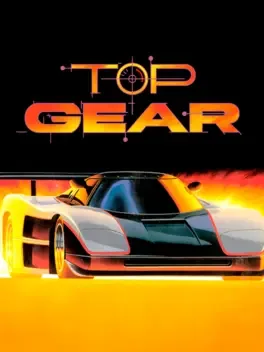
Top Gear
Introduction
Released in 1992, Top Gear (known as Top Racer in Japan) arrived as a defining title for the 16-bit racing genre. Developed by Gremlin Graphics and published by Kemco, it quickly became a staple of the Super Nintendo library. The game captures the essence of early 90s arcade racing, focusing on blistering speed, a high-energy soundtrack, and the competitive spirit of split-screen multiplayer. For many gamers of that era, the roar of the engines and the challenge of the global circuit remain core nostalgic memories. It wasn't just about crossing the finish line; it was about mastering the curves and managing resources under pressure.
Story & Setting
The narrative of Top Gear is driven by the ambition of becoming the world's premier racing champion. Players aren't confined to a single track or a local circuit; instead, they embark on a massive international tour. The game sends players over eight countries around the world, including the United States, United Kingdom, Germany, Italy, France, Japan, South America (specifically Brazil), and Scandinavia. Each country hosts four unique tracks, totaling 32 distinct races. The settings transition from sprawling cityscapes and coastal roads to treacherous mountain passes, providing a visual variety that was impressive for its time and keeping the global competition feeling fresh and expansive.
Gameplay
The core mechanics of Top Gear are built on high-speed, arcade-style racing. At the beginning of a championship, players choose one of four cars, each with distinct performance characteristics. These include variations in top speed, acceleration, and fuel efficiency. Unlike many simple racers of the time, this game introduces a layer of strategy through its pit stop mechanic. As players face sharp turns and dodge hazardous debris scattered across the road, they must keep a close eye on their fuel gauge. If the tank runs low, the player must pull into the pit lane for a quick refuel, a decision that can make or break a race.
Control is tight but demanding. Sharp turns require precise braking or drift-heavy steering to maintain momentum. Additionally, the game utilizes a permanent split-screen display. Even in single-player mode, the bottom half of the screen is occupied by a computer-controlled rival, maintaining the competitive tension at all times. To progress through the grueling 32-track tour, players use a password system, allowing them to save their standing and return to the international circuit later.
This game was released on several platforms, primarily focusing on Nintendo's 16-bit ecosystem across different regions.
Legacy
Top Gear left an indelible mark on the racing genre. It spawned several successful sequels, including Top Gear 2 and the futuristic Top Gear 3000, and its influence can still be seen in modern titles like Horizon Chase Turbo, which pays direct homage to its visual style and mechanics. Interestingly, the game achieved a unique cult status in Brazil and other parts of South America, where it is often cited as one of the most popular games for the Super Nintendo. Much of this legacy is tied to the iconic soundtrack composed by Barry Leitch, whose pulse-pounding melodies are still remixed and celebrated by fans today.
Fun Facts
- While the game is world-famous as Top Gear, it was released under the alternative name Top Racer in Japan to avoid licensing issues.
- The game's music isn't entirely original; Barry Leitch adapted many of the tracks from the Lotus Turbo Challenge series on the Amiga, which he also composed.
- The four cars available to players are loosely based on real-world supercars of the era, including the Ferrari Testarossa and the Lamborghini Countach.
- Each of the four cars has a different dashboard color and steering wheel design, providing a unique feel for each choice.