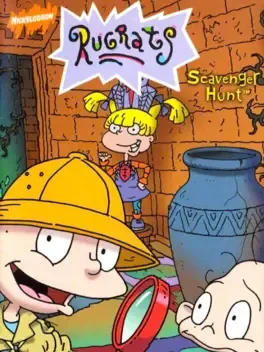
Rugrats: Scavenger Hunt
Introduction
In the late 1990s, few animated properties carried as much cultural weight as Nickelodeon’s Rugrats. Capturing the world through the imaginative eyes of toddlers, the series was a juggernaut of merchandise and media. In 1999, the franchise made its bold leap into the third dimension with Rugrats: Scavenger Hunt for the Nintendo 64. Developed by Realtime Associates and published by THQ, this title served as the babies' big debut on Nintendo’s powerful 64-bit hardware. Rather than a traditional platformer, the developers opted for a virtual board game experience, blending the humor of the cartoon with interactive 3D worlds. It was designed to bring families together, allowing fans to step into the diapers of their favorite characters in a quest for hidden treasures.
Story & Setting
The narrative of Rugrats: Scavenger Hunt is split across three distinct, imaginative scenarios that reflect the high-concept play sessions seen in the television show. In "The Pirate Treasure Hunt," Tommy and the gang find themselves submerged in an underwater adventure, navigating coral reefs and sunken ships to find buried loot. "Angelica's Temple of Gloom" shifts the tone to an Aztec-inspired ruin where players must recover pieces of Stu Pickles’ broken statues before the bossy Angelica can claim them. Finally, "Reptar Rally" takes the toddlers to the whimsical Candy Island, a sugary paradise where the goal is to collect as many sweets as possible.
Depending on the region, the game was known by several alternative names. In North America, it is primarily known as Rugrats: Scavenger Hunt, but it also appeared under the title Rugrats: Treasure Hunt. In French-speaking territories, it was released as Les Razmoket: La Chasse aux Tresors, while German fans recognized it as Rugrats: Die große Schatzsuche (or Rugrats: Die grosse Schatzsuche). Regardless of the title, the settings remained a colorful tribute to the show’s unique art style.
Gameplay
The core gameplay of Rugrats: Scavenger Hunt functions as a turn-based board game for up to four players. After choosing to play as Tommy, Chuckie, Phil, or Lil, players interact with a 3D board using a virtual spinner to determine their movement. The primary objective is to navigate the map and locate specific hidden objects before your opponents do. However, the boards are far from static; they are filled with special spaces that can drastically alter the course of a match.
Strategy comes into play with unique event spaces. For instance, landing on the Spike the Dog spot allows a baby to hop on the family pet and move forward five spaces instantly. Conversely, landing on a Dil spot causes the youngest Pickles to appear and shuffle the board, potentially ruining a player's progress. A unique mechanic to this game is the Energy Meter. Every action and movement consumes energy; if a character's meter reaches zero, they are forced to take a nap, missing turns until they are rested. This adds a layer of resource management rarely seen in children's board games of that era.
This game was released exclusively for the Nintendo 64, appearing in various regions including North America and Europe.
Legacy
Rugrats: Scavenger Hunt occupies an interesting space in the history of licensed video games. While it received mixed reviews from critics who found the gameplay a bit slow compared to the Mario Party series, it remains a nostalgic touchstone for those who grew up during the height of the "Nicktoon" era. It was one of the first times fans could see the Rugrats in fully realized 3D environments, paving the way for future titles like Rugrats in Paris: The Movie. Its legacy is defined by its attempt to translate the show's focus on friendship and imagination into a competitive but accessible multiplayer format.
Fun Facts
- Voice Talent: The game features the authentic voice cast from the television series, which helped maintain the show's signature atmosphere.
- Energy Management: The "nap time" mechanic was a clever way to incorporate toddler behavior into game design, serving as the equivalent of a "stun" or "skip turn" mechanic in other board games.
- 3D Transition: This was the first time the Rugrats characters were modeled in 3D for a home console, a significant technical milestone for the franchise at the time.
- Board Dynamics: Unlike many other board games of the era, the boards in Scavenger Hunt were fully 3D environments that players could rotate and view from different angles to spot hidden items.