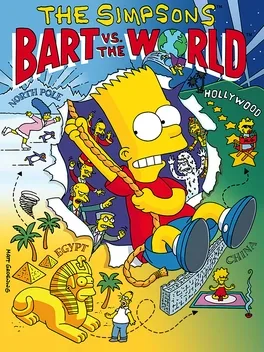
The Simpsons: Bart vs. the World
Introduction
Relive the era of "Eat My Shorts" and "Cowabunga." The Simpsons: Bart vs. the World (often referred to by the shorthand "Bart World" in certain circles) was the follow-up to the notoriously difficult Bart vs. the Space Mutants. Released at the height of the show's global popularity, this game took the eldest Simpson child on a global scavenger hunt designed to thwart the vengeful Mr. Burns. It moved away from the spray-painting mechanics of its predecessor in favor of a more traditional platforming experience combined with variety-style mini-games which helped flesh out the depth of the adventure. For many fans of early 90s gaming, this title was a staple of their collection, offering a vibrant look into the world of Springfield beyond its usual boundaries.
Story & Setting
The plot kicks off when Bart Simpson wins a worldwide art contest. The prize is a prestigious trip around the globe, visiting exotic locations such as China, Egypt, the North Pole, and Hollywood. However, unbeknownst to the family, the contest was rigged by Mr. Burns. The billionaire mogul seeks revenge for past slights and has tasked various members of the Burns clan to eliminate Bart during his travels. This globetrotting premise allowed developers to create diverse environments far beyond the streets of Springfield, turning the Simpson family's vacation into a fight for survival across snowy peaks and ancient pyramids. Each locale is themed with unique enemies and obstacles that reflect the regional setting, all while keeping the show's signature humor intact.
Gameplay
At its core, the game is a side-scrolling platformer. Players control Bart as he navigates treacherous terrain, jumping over pits and avoiding enemies. For defense, Bart can throw firecracker balls at his enemies, providing a more direct way to engage with foes than in previous entries. To stay healthy, he must find Squishees, the sugary Springfield staple that restores his health meter. One of the most exciting additions is the Bartman transformation. By grabbing a specific cape, Bart becomes his superhero alter-ego, gaining the ability to fly for limited periods, which is often necessary to bypass difficult obstacles or reach hidden areas. Progression isn't just about reaching the end of a stage. Bart needs to collect Krusty-brand souvenirs. There is one hidden in every stage, and finding them all is the only way to achieve the best ending. This encourages thorough exploration of the multi-level environments. The experience is broken up by several mini-games located in each area. These include card-matching puzzles to test memory and trivia games that challenge the player's knowledge of actual episodes from the show's early seasons, adding a nice touch of fan service for dedicated viewers.
The game was widely accessible during the early 1990s, appearing on several home consoles and handheld devices.
Legacy
While Bart vs. the World received mixed reviews at launch, it is often remembered more fondly than its predecessor due to its improved jumping physics and more responsive controls. It represents a specific era of licensed gaming where developers experimented with blending genres—platforming, trivia, and puzzles—to capture the essence of a TV show. For many, it remains a nostalgic piece of the LJN and Acclaim library, illustrating how the Simpsons franchise dominated not just television, but the gaming landscape of the 8-bit and 16-bit generations. Its legacy is tied to the "Bartmania" that defined the early 90s, where this title proved to be one of the more competent releases from that licensing gold rush.
Fun Facts
The trivia mini-games were quite difficult for casual fans, as they required specific knowledge of the first two seasons of the show. Many of the bosses in the game are actually members of the Burns family tree created specifically for the game to serve as antagonists. Additionally, the Game Gear version is often cited as being particularly challenging due to the smaller screen real estate making the platforming sections more punishing for players who were used to the console versions. Interestingly, the game features cameos from many secondary characters like Moe and Barney, who appear in the background or within mini-games.