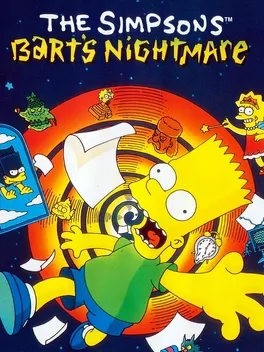
The Simpsons: Bart's Nightmare
Introduction
In the early 1990s, "Simpsons-mania" was at its absolute peak. Every medium wanted a piece of the rebellious Bart Simpson, and the video game industry was no exception. Developed by Sculptured Software and published by Acclaim, The Simpsons: Bart's Nightmare arrived in 1992 as a surreal departure from the standard platformers of the era. Rather than a linear progression through Springfield, players were treated to an eclectic collection of mini-games bound together by a dream-logic hub world. It remains one of the most visually distinctive and challenging titles in the franchise's extensive gaming history, capturing the irreverent spirit of the show's early seasons.
Story & Setting
The narrative premise is one that many students can relate to: the last-minute homework panic. Bart Simpson falls asleep while attempting to write a class paper, having procrastinated until the very late hours of the night. In his slumber, his homework pages catch a breeze and fly out the window, scattering across a dreamscape version of Springfield.
Bart must navigate this "Windy World" to recover the eight lost pages. The setting is a purple-hued, psychedelic version of his hometown, populated by floating saxophones, living mailboxes, and various members of the Simpson family who act as both obstacles and aids. To wake up with a passing grade, Bart must confront his deepest fears and wildest fantasies within his subconscious mind.
Gameplay
The gameplay is divided into two distinct layers. The first is the hub world, known as Windy World. Here, Bart walks down a never-ending street in a pseudo-3D perspective. He must dodge bullies like Jimbo and Kearney, avoid the soul-sucking kisses of his aunts Patty and Selma, and jump over various hazards. When Bart finds a lost page, he must jump onto it to enter a mini-game level.
There are five main dream sequences, each accessible via different colored doors or objects:
- Bartman (Purple): A side-scrolling shooter where Bart flies over Springfield as his superhero alter-ego.
- Bartzilla (Green): A parody of classic monster movies where Bart stomps through the city, eventually climbing a skyscraper to fight "Homer-thra."
- Itchy & Scratchy (Yellow): A violent, house-based combat level that mirrors the slapstick gore of the show-within-a-show.
- Bart's Bloodstream (Blue): A unique level where Bart must swim through his own veins to pop germs and collect oxygen.
- Indiana Bart (Orange): A temple-exploration level that pays homage to the Indiana Jones films, requiring precise platforming over disappearing tiles.
Successfully completing a dream rewards Bart with a page. Once all pages are collected—or if Bart loses all his health—he wakes up to receive a grade from Principal Skinner based on the player's performance.
This game was released on several platforms, including the 16-bit powerhouses of the time and their international equivalents.
In Japan, the game was released under the title Bart no Fushigi na Yume no Daibouken, which translates to "Bart's Mysterious Dream Adventure."
Legacy
The Simpsons: Bart's Nightmare is often remembered for its impressive graphical fidelity. For 1992, the sprites and animations were remarkably close to the actual cartoon, a feat that many previous NES titles struggled to achieve. However, it is also notorious for its high difficulty curve. The Windy World hub can be punishing, and the lack of clear instructions for some mini-games left many players frustrated. Despite this, the game's variety and creative use of the license have earned it a cult following. It stands as a testament to a time when licensed games were willing to experiment with weird, abstract concepts rather than sticking to safe, cookie-cutter designs.
Fun Facts
- The game features a unique grading system at the end; you can receive anything from an "F" to an "A" based on how many pages you recover.
- If Bart loses too much health in the hub world, he transforms into a crying baby, and the game ends shortly after.
- The "Bartzilla" level features two distinct stages: a city-stomping segment and a final showdown atop a building.
- While most characters are enemies, Lisa Simpson appears as a fairy to turn Bart back into a human if he is transformed into a frog by a kissing donkey.