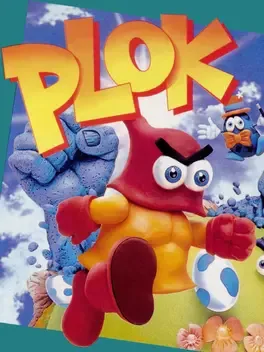
Plok
Introduction
In the golden age of 16-bit platformers, the Super Nintendo Entertainment System was home to dozens of mascots, but few were as bizarre or as charming as Plok. Developed by the talented British team at Software Creations and released in 1993, Plok offered a refreshingly unique take on the side-scrolling genre. While contemporaries like Mario and Sonic relied on speed or jumping on heads, Plok introduced a mechanic that literally involved the protagonist giving pieces of himself to defeat his enemies. With its vibrant colors, incredible sound design, and steep difficulty curve, the game quickly cemented itself as a cult favorite among SNES enthusiasts.
Story & Setting
The adventure unfolds on the vibrant and eccentric Akrillic Island. The story begins with a simple, albeit frustrating, conflict: someone has stolen Plok’s favorite big square flag from his house on Cotton Island. As the self-proclaimed king of Akrillic, Plok embarks on a journey across various regions—ranging from lush forests to rocky cliffs—to reclaim his prize. However, upon returning with his flag, he discovers a much larger threat: his entire homeland has been overrun by the nefarious Fleas. These blue, hopping pests have infested every corner of the world, forcing Plok to dive deep into the island’s caverns and history to eradicate the invasion and restore peace to his kingdom.
Gameplay
The core mechanic of Plok is what truly sets it apart from other platformers of the era. Plok has the ability to launch his own limbs—arms and legs—as projectiles to attack enemies or trigger switches. While this gives him a versatile range of attack, there is a strategic catch: the more limbs Plok throws, the more vulnerable he becomes. If he launches all four limbs, he is reduced to a hopping torso, unable to attack and significantly limited in movement until his limbs fly back to him.
Beyond his basic abilities, the game features a variety of transformative power-ups found in "presents." These costumes grant Plok temporary abilities, such as turning into a flamethrower-wielding soldier, a boxer, or even a tank driver. The level design often requires clever use of these power-ups and careful limb management to navigate past traps and defeat massive bosses. Additionally, the game is notorious for its high level of difficulty, featuring long levels without a traditional save system, though players can find hidden warps to skip portions of the adventure.
This game was released on several platforms, including the Super Famicom in Japan and the Super Nintendo Entertainment System in North America and Europe.
Legacy
Though Plok never spawned a massive franchise like some of its peers, its legacy persists through its incredible technical achievements and unique personality. One of the most celebrated aspects of the game is its soundtrack, composed by the legendary Tim and Geoff Follin. Utilizing advanced programming techniques, they pushed the SNES sound chip to its absolute limits, creating a rock-infused score that remains one of the most respected in retro gaming history. In recent years, the creators, the Pickford Brothers, have kept the character alive through a long-running webcomic, and the game’s reputation as a "hardcore" platformer ensures it continues to be discussed in retro-gaming circles decades later.
Fun Facts
- Plok was originally conceived as the star of an arcade game titled "Fleapit," which was developed for rare hardware but never officially released.
- The game features a series of "Grandpappy Plok" levels, which are presented in sepia tones to represent the past, showing Plok's grandfather searching for the flag years prior.
- Despite being a colorful and inviting platformer, the game is famous for its lack of a password or save feature in the original release, making completing the game in one sitting a true test of endurance.
- The name of the world, "Akrillic," is a clever play on the word "acrylic," fitting the game's bright, artistic visual style.
- Shigeru Miyamoto was reportedly impressed by the game's animation and limb-throwing mechanic during its development.