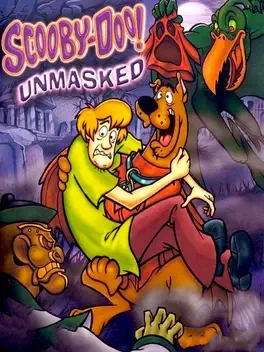
Scooby-Doo! Unmasked
Introduction
Scooby-Doo has always been a staple of Saturday morning cartoons, but his transition into the world of video games has seen various interpretations over the decades. Released in 2005, Scooby-Doo! Unmasked (also known as Scooby-Doo! Démasqué in French-speaking regions) represents one of the most polished entries in the Mystery Inc. gaming library. Developed by Artificial Mind and Movement (A2M), this title captured the essence of the classic Hanna-Barbera show while introducing unique mechanics that set it apart from its predecessors. It manages to balance the whimsy of the cartoon with the technical demands of a 3D platformer, offering an experience that is both accessible to children and engaging for longtime fans of the franchise.
Story & Setting
The narrative kicks off when the Mystery Machine pulls up to Mubbery Studios, a world-renowned special effects workshop owned by Fred’s cousin, Jed. However, the usual excitement of a Hollywood-style visit is quickly replaced by dread when the gang discovers Jed has mysteriously vanished. To make matters worse, the studio’s advanced "Mubber" technology—a substance capable of creating realistic animatronics—is being used to bring terrifying movie monsters to life. Scooby-Doo and his friends must navigate various movie sets, from a spooky Chinatown to a creepy circus and a prehistoric world, to find Jed and unmask the mastermind behind the chaos. The setting provides a brilliant excuse for diverse level design, as each "set" functions as its own unique world with specific thematic challenges.
Gameplay
At its heart, Scooby-Doo! Unmasked is a 3D platformer that emphasizes exploration, combat, and puzzle-solving. The core mechanic revolves around Scooby-Doo himself, who must navigate treacherous environments and take down enemies. A key element of the gameplay is collecting clues for Velma; these clues are essential for piecing together the mystery and progressing the plot.
The most innovative feature, however, is the costume system. Scooby can change into various outfits that grant him specialized abilities. For example, the Kung-Fu costume allows him to engage in martial arts combat to defeat enemies, while the Bat costume enables him to glide across large gaps and reach high platforms. There is also a Robin Hood-inspired Archer outfit for long-range attacks. Many levels are designed with these specific powers in mind, making certain areas impossible to finish without utilizing the correct costume. This adds a layer of light Metroidvania-style backtracking and strategy to the traditional platforming loops. For players on the Nintendo DS, the game further utilized the hardware by including several touchscreen-based minigames that offered a break from the main platforming action.
This game was released on several major platforms of its era, ensuring that fans of different consoles could join in on the mystery-solving fun.
Legacy
Scooby-Doo! Unmasked is often remembered as the third entry in a loosely connected trilogy of Scooby-Doo games published by THQ, following Night of 100 Frights and Mystery Mayhem. While it didn't necessarily reinvent the platforming genre, it was praised for its faithful art style and the inclusion of the original voice cast, which added a layer of authenticity that fans appreciated. It remains a nostalgic favorite for those who grew up in the mid-2000s, often cited for its solid level design and the fun variety provided by the costume mechanics. It stands as a testament to a time when licensed games were beginning to find a balance between brand loyalty and genuine gameplay quality.
Fun Facts
One of the most distinct stylistic choices in the game is its audio design. This is notably the third Scooby-Doo game to feature a laugh track, mimicking the format of the original 1969 television series to create a "sitcom" atmosphere. Additionally, for players on the Nintendo DS, the game offered a unique experience by integrating the touchscreen for specific puzzle-solving segments. The game also features numerous cameos and references to various classic Scooby-Doo villains from the past, serving as a love letter to the long-running franchise's history.