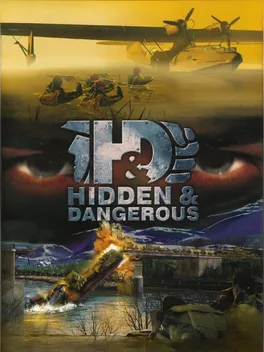
Hidden & Dangerous
Introduction
Story & Setting
Gameplay
Platforms
Legacy
Fun Facts
Introduction
In the late 1990s, the landscape of military shooters was dominated by fast-paced action. However, a title emerged that demanded patience, precision, and tactical prowess: Hidden & Dangerous. Often referred to by its alternative name Hidden and Dangerous, this groundbreaking title by Illusion Softworks introduced a level of squad management and realism that few contemporaries could match. It challenged players to step into the boots of an elite SAS squad, where success was measured not by body count, but by the successful execution of complex objectives behind enemy lines. It remains a landmark title for those who prefer cerebral planning over impulsive shooting.
Story & Setting
Set during the height of the Second World War, Hidden & Dangerous immerses players in the clandestine world of Allied commandos. The narrative follows a hand-picked squad of soldiers as they embark on high-risk operations across various European theaters. The campaign is structured into several distinct episodes, each transporting the player to a different geographical location. You might find yourself navigating the snowy peaks of Norway to sabotage a heavy water plant, or creeping through the dense forests of Yugoslavia to aid local resistance movements. Each mission is a self-contained story of bravery, requiring players to adapt to the environmental challenges and the specific political landscape of the region. The game captures the tension of being outnumbered and outgunned, emphasizing the importance of stealth and the element of surprise in enemy territory.
Gameplay
The gameplay of Hidden & Dangerous is a sophisticated blend of action and strategy. Players manage a roster of soldiers, each with individual stats like shooting accuracy, stealth, and strength. Before each mission, you must carefully select four commandos and equip them with an appropriate loadout of weapons, explosives, and medical supplies. Choosing the right gear is vital, as weight and inventory space are limited.
Once on the ground, the game offers a unique hybrid control scheme. Players can directly control any one of the four commandos in a first-person or third-person perspective, engaging in traditional combat. However, the true depth lies in the Tactics Mode. By pausing the action and switching to a top-down view, players can plan synchronized maneuvers. You can set waypoints, dictate the stance of your soldiers (standing, crouching, or crawling), and coordinate ambushes where multiple team members strike at the exact same moment.
Mission objectives are varied and never repetitive. One operation might focus on bomb planting at a naval facility, while another requires the silent rescue of Allied pilots from a prisoner-of-war camp. To facilitate these large-scale maps, the game allows players to drive various period-accurate vehicles. Taking control of a German Kubelwagen or even a heavy tank provides a significant tactical advantage, though it often sacrifices the stealth that is so crucial for most missions. The realism is uncompromising, requiring players to think like actual squad leaders.
This game was released on several platforms, including the Dreamcast and the PlayStation.
Legacy
The legacy of Hidden & Dangerous is firmly rooted in the evolution of the tactical shooter genre. It proved that there was a massive appetite for games that prioritized simulation and realism over arcade-style mechanics. It served as a direct inspiration for later squad-based titles and established Illusion Softworks as a premier developer of tactical experiences (later becoming 2K Czech and working on the Mafia series). The game eventually received a sequel, Hidden & Dangerous 2, which refined the mechanics even further. To this day, fans celebrate the "Deluxe" version of the original, which was released for free in 2003 to promote the brand, ensuring that new generations of gamers can experience the tension of WW2 commandos.
Fun Facts
- The game's development was famously difficult due to the complexity of the engine, leading to numerous bugs in the initial release that were later patched in the "Deluxe" edition.
- The recruitment screen allowed you to choose from a pool of soldiers, and if a soldier died during a campaign, they were gone for good, adding a permadeath layer that increased emotional investment.
- Despite being a British-centric game focused on the SAS, it was developed by a Czech studio, providing a unique Eastern European perspective on Western Allied operations.