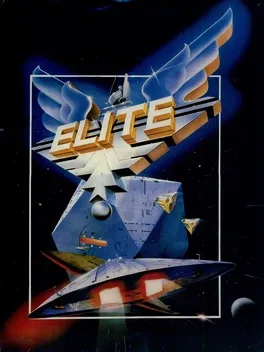
Elite
Introduction
In September 1984, the landscape of home computing changed forever with the release of Elite. Developed by David Braben and Ian Bell, and originally published by Acornsoft for the BBC Micro and Acorn Electron, Elite was a technical marvel that defied the limitations of its era. At a time when most games were simple 2D platformers or fixed-screen shooters, Elite offered a vast, wire-frame 3D universe that felt truly infinite. Its open-ended game model and revolutionary graphics led to it being ported to virtually every contemporary home computer system, earning it a permanent place as a classic and a primary genre maker in gaming history.
Story & Setting
Set in a sprawling universe comprised of eight galaxies, Elite provides a narrative framework that is largely dictated by the player's own choices. However, the world-building is deeply enhanced by the inclusion of The Dark Wheel, a novella by Robert Holdstock bundled with the original release. This novella gave players crucial insight into the moral and legal codes of the universe, providing a backdrop of space-faring lore and the mysterious organizations that inhabit the stars. Players begin their journey at Lave Station with a modest Cobra Mk III ship and a mere 100 credits, tasked with carving out a life among 2,048 unique planets, each with its own economy, government type, and technological level.
Gameplay
Elite is the definitive space trading and combat simulator. The gameplay is famously non-linear, allowing players to choose their own path. You can be a law-abiding merchant, a daring asteroid miner, or a ruthless pirate. The core loop involves buying low and selling high—transporting goods like food, minerals, or even illegal narcotics between systems to earn credits for ship upgrades. Combat is a "twitch" gameplay experience, requiring precision as you engage in dogfights against pirates or planetary police. The game's title derives from the ultimate player goal: raising your combat rating through thousands of kills to the exalted rank of "Elite." One of the most iconic technical achievements was the use of wire-frame 3D graphics with hidden line removal, which provided a sense of depth and scale that was previously unheard of on home hardware.
This game was released on several platforms, including the BBC Micro, Commodore 64, and the Nintendo Entertainment System.
Legacy
Elite is widely considered one of the most influential video games ever created. By establishing the space trading genre, it paved the way for modern masterpieces like EVE Online, No Man's Sky, and its own modern successor, Elite Dangerous. It was one of the first titles to demonstrate that a game didn't need a "Game Over" screen or a linear path to be engaging. Its influence on procedural generation remains a cornerstone of game design, showing how massive worlds could be generated from tiny amounts of code. Decades later, it remains a touchstone for developers seeking to create immersive, systemic worlds where the player is the master of their own destiny.
Fun Facts
- To save memory, the names and characteristics of all 2,048 planets were generated using a Fibonacci-based procedural generation sequence, fitting the entire universe into just 22 kilobytes.
- The manual docking sequence was so difficult for new players that the "Docking Computer" became one of the most sought-after and expensive upgrades in the game.
- David Braben and Ian Bell were still students at Cambridge University when they developed the core engine for the game.
- Elite was one of the first games to use a novella to provide "external" narrative context, a move necessitated by the limited on-screen text capabilities of 1980s computers.