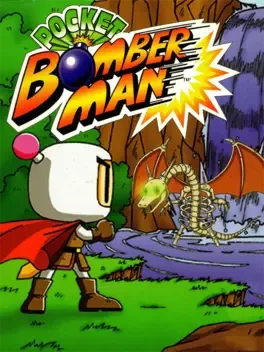
Pocket Bomberman
Introduction
Pocket Bomberman represents a fascinating departure from the standard top-down maze-based gameplay that defined the franchise since its inception in the early 1980s. While most players associate Hudson Soft's iconic mascot with grid-locked tactical explosions, this title took the hero into the realm of 2D side-scrolling platformers. Originally released for the Game Boy, it arrived during a period of hardware transition, eventually seeing a color-enhanced version for the Game Boy Color shortly after. It stands as a testament to the versatility of the character and the creativity of developers looking to refresh established intellectual properties for handheld audiences. This title proved that the core mechanics of bomb-laying could be successfully translated into a different genre without losing the series' signature charm.
Story & Setting
The narrative of Pocket Bomberman provides a charming backdrop for the explosive action. The adventure spans several distinct environments, each with its own visual theme and unique hazards. Players guide the white-clad hero through various worlds, such as a lush jungle filled with carnivorous plants, a deep ocean teeming with hostile aquatic life, a windy mountain range, and a final mechanical fortress. The ultimate goal is to navigate these perilous zones and confront the malevolent forces threatening the peace. Each world is divided into several stages, culminating in a climactic boss encounter that tests the player's mastery over bomb-throwing and environmental awareness. This journey takes the character into a quest that feels more like an epic platforming adventure than a simple series of maze-based puzzle rooms.
Gameplay
Unlike the traditional grid movement found in most entries of the series, Pocket Bomberman features a side-view perspective where gravity and jumping play central roles. This shift changes everything about how bombs are used. Instead of just placing them on a tile and running away, Bomberman can now throw or drop them while navigating platforms. The bombs have physics, meaning they can roll down slopes, bounce off walls, or be kicked across gaps to hit distant triggers. This adds a significant puzzle-platforming element to the game, as players must time their jumps and explosions to hit enemies while avoiding their own blasts.
There are five main worlds in total, each consisting of five levels and a final boss encounter. To progress through a level, players must defeat all enemies on screen to open the exit. Collecting power-ups is still a core component of the experience, and searching for them within the destructible blocks of each level is vital for success. Familiar items like Fire Up, which increases blast radius, and Bomb Up, which increases the number of bombs on screen, return alongside others like the useful Remote Control. The bosses are massive sprites that require specific patterns and precise bomb placement to overcome, providing a significant step up in challenge.
This game was released on several platforms, including the original handheld Game Boy and the enhanced Game Boy Color.
Legacy
Pocket Bomberman is remembered as one of the more unique entries in the massive Bomberman library. While it wasn't the first time the series experimented with platforming, it was one of the most successful adaptations for a portable 8-bit console. Critics at the time praised its clean graphics and the clever integration of bomb mechanics into a platforming space. It remains a cult favorite among Game Boy enthusiasts who appreciate games that push the boundaries of their established franchises. The transition to the Game Boy Color version helped highlight the vibrant art style that Hudson Soft was known for, making it a visual treat for the era and ensuring its place in the history of the platform.
Fun Facts
- Pocket Bomberman is one of the few games in the series where Bomberman can jump manually without the aid of a specific power-up or a specialized tile.
- The game features a dedicated Jump button, which was a radical change for fans used to the classic maze-based control scheme.
- In the Game Boy Color version, the game features a special border if played on a Super Game Boy, despite being a newer title.
- The game includes a "Jump Game" mini-game that allows players to earn extra lives and power-ups between the main worlds.
- Despite the platforming focus, the game's engine was actually used as a solid base for other portable titles during that era due to its reliable sprite handling.