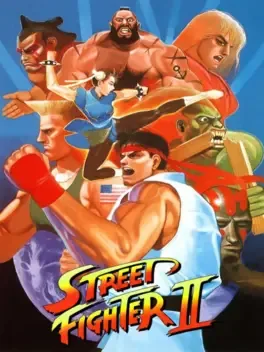
Street Fighter II
Introduction
When Street Fighter II: The World Warrior hit arcades in 1991, it didn't just release a new game; it ignited a global phenomenon. Developed and published by Capcom, this title served as the sequel to the relatively obscure 1987 original, but it improved upon its predecessor in every conceivable way. It effectively established the blueprint for the one-on-one fighting game genre, introducing mechanics and character archetypes that remain industry standards decades later. Whether in a smoky arcade or on a living room television, Street Fighter II became the ultimate test of skill, reflexes, and psychological warfare between two players.
Story & Setting
While fighting games are often praised for their mechanics, Street Fighter II featured a colorful and diverse cast that gave the action a sense of global scale. The narrative centers around a world-class martial arts tournament organized by the sinister Shadaloo crime syndicate, led by the dictatorial M. Bison. The tournament attracts eight primary fighters from different corners of the globe, each with their own personal motivations.
From the wandering Japanese martial artist Ryu and his American rival Ken Masters to the Chinese Interpol agent Chun-Li seeking revenge for her father, the characters were more than just sprites; they were icons. The settings were equally evocative, taking players from the bustling markets of China and the bathhouses of Japan to the jungles of Brazil and the military bases of the United States. This international flavor gave the game a unique identity, making every match feel like a cinematic clash of cultures and fighting styles.
Gameplay
At its core, Street Fighter II is a masterclass in balance and precision. It introduced the revolutionary six-button control scheme, which allowed players to execute three strengths of punches and kicks. This system provided a layer of tactical depth previously unseen in the genre. Players had to master "command inputs"—specific joystick motions combined with button presses—to unleash special moves like Ryu’s Hadouken or Guile’s Sonic Boom.
One of the most significant accidental discoveries in gameplay history occurred here: the combo system. Originally a bug that allowed players to cancel the animation of one move into another, Capcom decided to keep it, creating a deep layer of high-level play where timing was everything. The game also perfected the "rock-paper-scissors" dynamic of blocking, throwing, and striking. Each of the eight characters felt distinct; Zangief relied on heavy-hitting wrestling grabs, while Dhalsim used his reaching limbs to keep opponents at a distance. This variety ensured that no two matches ever played out the same way.
This game was released on several platforms, including the Super Nintendo Entertainment System and various modern digital storefronts.
Legacy
The legacy of Street Fighter II is impossible to overstate. It is widely credited with revitalizing the arcade industry in the early 1990s and kickstarting the "golden age" of fighting games. Its success led to countless iterations, including Champion Edition, Hyper Fighting, and Super Street Fighter II, which added new characters and refined the speed of the game.
Beyond its own sequels, it influenced every fighting franchise that followed, from Mortal Kombat to Tekken. It also laid the groundwork for the modern esports scene. The competitive community that grew around Street Fighter II helped birth major tournaments like EVO (Evolution Championship Series). Even today, professional players and enthusiasts look back at this title as the foundation of competitive gaming culture.
Fun Facts
- The Combo Glitch: As mentioned, the ability to chain attacks together was originally a bug in the code. The developers noticed it during testing but thought it was too difficult to execute for it to matter. It ended up becoming the most important mechanic in fighting game history.
- The Boss Name Swap: To avoid legal issues with Mike Tyson, the names of three boss characters were rotated for the Western release. The boxer (M. Bison in Japan) became Balrog, the clawed Spaniard (Balrog in Japan) became Vega, and the final boss (Vega in Japan) became M. Bison.
- First Female Fighter: Chun-Li holds the title of the first-ever playable female character in a one-on-one fighting game, breaking barriers in the male-dominated gaming landscape of the early 90s.
- The Shen Long Hoax: An April Fools' joke by Electronic Gaming Monthly suggested a secret character named Shen Long could be unlocked. This rumor was so persistent that Capcom eventually created the character Akuma (Gouki) to satisfy the fans' desire for a hidden boss.