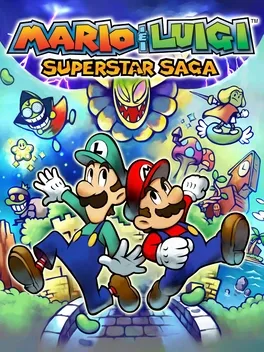
Mario & Luigi: Superstar Saga
Introduction
Released in 2003, Mario & Luigi: Superstar Saga marked a vibrant and comedic shift for Nintendo’s most famous siblings. Developed by AlphaDream, the game brought a unique role-playing experience to the Game Boy Advance, blending traditional turn-based combat with reflex-based action. Known in various markets by different titles, such as Mario & Luigi RPG in Japan or 马力欧与路易吉RPG in China, it immediately stood out for its sharp writing and expressive animation. Unlike the more serious tone of some contemporary RPGs, this title leaned into the absurdity of the Mario universe, establishing a sub-series that would become a beloved staple of Nintendo’s handheld library.
Story & Setting
The adventure begins when an ambassador from the neighboring Beanbean Kingdom arrives at Princess Peach’s castle. However, the visit is a ruse: the ambassador is actually the wicked witch Cackletta in disguise. Alongside her eccentric and perpetually grinning henchman, Fawful, she steals Princess Peach’s voice, replacing her fair speech with literal explosives that detonate whenever she tries to speak. Mario and Luigi quickly set off to the Beanbean Kingdom to recover the stolen voice. In a hilarious twist of fate, they are joined by their sworn enemy, Bowser, who is just as annoyed as they are because he cannot kidnap a princess who might blow up his castle every time she opens her mouth. This unlikely alliance sets the stage for a journey through diverse locales like the Hoohoo Mountain and the Chucklehuck Woods.
Gameplay
The core of the gameplay involves the innovative "Bros." system. Players control both Mario and Luigi simultaneously on the overworld; Mario is typically mapped to the 'A' button, while Luigi follows behind, mapped to the 'B' button. To navigate the environment, players must learn and combine new moves, such as the High Jump or the Spin Jump, where the brothers interact to reach new heights or cross wide gaps.
In combat, the game utilizes a turn-based system that rewards player timing. By pressing the correct button just as an attack lands, players can deal extra damage or trigger "Bros. Attacks"—powerful tag-team moves that consume Bros. Points. Defensively, players can dodge or counter enemy strikes entirely if their timing is precise. Beyond combat, the world is filled with an abundance of minigames like Border Jump and Mystery Carts, which offer a break from the main quest while providing valuable rewards. The cartoonish visuals and hit music from previous Mario games, reimagined for the Beanbean Kingdom, create a truly immersive atmosphere.
This game was originally released for the Game Boy Advance and has since been made available through digital services on later consoles. In South Korea, the game is recognized by the title 마루알 1.
Legacy
Mario & Luigi: Superstar Saga is often cited as one of the best RPGs on the Game Boy Advance. It successfully distilled the complex mechanics of the genre into a portable format without losing depth. Its legacy lives on through numerous sequels, including Partners in Time and Bowser’s Inside Story. The character Fawful, in particular, became a fan favorite due to his bizarre dialogue and recurring role as a villain. The game eventually received a full remake on the Nintendo 3DS, proving that its charm and gameplay loop remain timeless even decades after the original release.
Fun Facts
- The game features a cameo from Professor E. Gadd, the inventor from Luigi's Mansion, who runs the Starbeans Cafe.
- The soundtrack was composed by Yoko Shimomura, who is also famous for her work on the Kingdom Hearts and Street Fighter series.
- Despite being a Mario game, the majority of the adventure takes place outside the Mushroom Kingdom in the pun-filled Beanbean Kingdom.
- During development, the game was intended to have a much larger cameo section featuring characters from other Nintendo franchises, but many were cut for time.