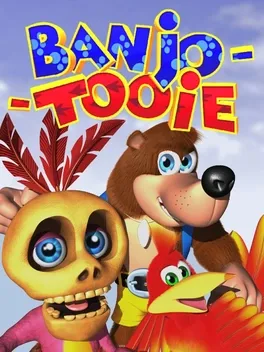
Banjo-Tooie
Introduction
In the golden era of 3D platformers, few titles reached the ambitious heights of Banjo-Tooie. Released in 2000 as the direct successor to the beloved Banjo-Kazooie, this sequel was designed to be bigger, bolder, and significantly more complex than its predecessor. Often referred to by fans during its hype cycle as Banjo Kazooie 2, the game had the difficult task of following one of the most critically acclaimed titles on the Nintendo 64. In Japan, it was known as Banjo to Kazooie no Daibouken 2, but regardless of the name, it delivered a gaming experience that pushed the console to its absolute technical limits. It stands today as a masterclass in sequel design, taking the foundation of the original and expanding it into a massive, interconnected epic.
Story & Setting
The narrative of Banjo-Tooie kicks off with a surprisingly dark and high-stakes opening. Two years after the defeat of the wicked witch Gruntilda, her sisters Mingella and Blobbelda arrive in a massive drilling machine called the Hag 1 to rescue her. They succeed in extracting Grunty’s skeletal remains, but not before destroying the bear and bird’s home and killing their friend, Bottles the Mole. Driven by revenge and the need to restore the life force Grunty is stealing from the island, Banjo and Kazooie set out into the Isle o' Hags.
The world-building here is far more atmospheric and expansive than the first game. The setting moves away from the whimsical hub of Gruntilda’s Lair and into a sprawling island full of diverse ecosystems. From the prehistoric valleys of Terrydactyland to the grimy, labyrinthine hallways of the Grunty Industries factory, the environments are rich with detail. One of the most memorable locations is Witchyworld, a dilapidated and dangerous amusement park that perfectly encapsulates the game's quirky and slightly macabre sense of humor.
Gameplay
While the first game was a straightforward "collectathon," Banjo-Tooie introduced layers of complexity that redefined the genre. Players start with all the moves they learned in the prequel, but they soon acquire dozens of brand-new abilities. A revolutionary mechanic for the series was the ability to split the duo apart. By stepping on Split-Up pads, players can control Banjo and Kazooie independently, each with their own unique physics and exclusive moves. This added a deep layer of puzzle-solving, as many Jiggies require the characters to be in different places simultaneously.
The level design is famously interconnected. In Banjo to Kazooie no Daibouken 2, puzzles are no longer confined to a single world. You might find a train station in one world that needs to be unlocked so you can transport a character or item to a completely different world. This "macro-puzzle" design encourages exploration and backtracking in a way that feels organic. Furthermore, the game introduced first-person shooter segments using the "Breegull Blaster" mechanic, transformations by the shaman Humba Wumba, and the ability to play as Mumbo Jumbo himself to cast powerful world-altering spells.
This classic adventure was originally developed to showcase the power of the Nintendo 64, utilizing its hardware to create seamless transitions and massive draw distances for the time.
Legacy
Banjo-Tooie remains a landmark title in the history of Rare Ltd. and the 3D platforming genre. While some players at the time were overwhelmed by its sheer scale and the amount of backtracking required, it has aged gracefully as a deep, rewarding experience for those who love exploration. It proved that sequels could be more than just "more of the same," offering a darker tone and more intricate mechanics that challenged the player's intelligence. Its influence can still be seen in modern "Metroidvania" games and 3D collectathons that prioritize world-connectivity over linear progression.
Fun Facts
- The game finally delivered on the "Stop 'n' Swop" mystery from the first game, allowing players to retrieve hidden eggs and the Ice Key.
- A multiplayer mode was included, featuring competitive mini-games and a four-player first-person shooter mode.
- The legendary composer Grant Kirkhope returned to create a dynamic soundtrack that shifts instruments based on the player's location within a level.