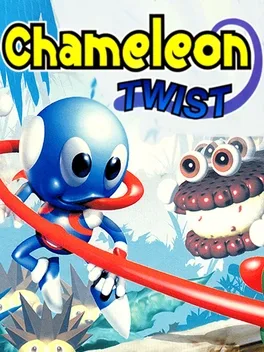
Chameleon Twist

Chameleon Twist\n\n- Introduction\n- Story & Setting\n- Gameplay\n- Platforms\n- Legacy\n- Fun Facts\n\n## Introduction\n\nThe mid-to-late 1990s represented a golden age for the 3D platformer, a time when developers were still figuring out the rules of three-dimensional space. Among the heavy hitters like Super Mario 64 and Banjo-Kazooie sat a quirky, innovative title from Japan System Supply: Chameleon Twist. Released by Sunsoft in 1997 for the Nintendo 64, this game eschewed the traditional run-and-jump formula in favor of a unique, physics-based mechanic centered around a very long, very versatile tongue. It remains a fascinating example of the creative risks developers took during the transition to 3D gaming, offering a colorful and surreal experience that stood out in a crowded market of animal-themed mascots.\n\n## Story & Setting\n\nThe narrative of Chameleon Twist begins with a scene reminiscent of Alice in Wonderland. A small blue chameleon named Davy is going about his day when he spots a mysterious rabbit rushing into a magical hole in the ground. Driven by curiosity, Davy follows the creature and falls into a portal. Upon emerging on the other side, he discovers that the magical energies of the world have transformed him into a humanoid version of himself. To find a way back home, Davy must navigate through six distinct and imaginative lands to locate a specific magic portal that will return him to his original state.\n\nHe isn't alone on this journey; throughout the game, he is joined by his colorful companions Jack, Fred, and Linda. Their adventure takes them through a variety of surreal environments that defy traditional logic. They begin in the lush greenery of Jungle Land before descending into the oversized insect world of Ant Land. The journey continues through the explosive obstacles of Bomb Land, the sandy corridors of Desert Castle, and the toy-filled whimsicality of Kids Land. Finally, they must brave the eerie depths of Ghost Castle. Each world is guarded by a massive boss that serves as the final barrier to the magic portal.\n\n## Gameplay\n\nThe defining feature of Chameleon Twist is Davy’s tongue. While most platformers of the era focused on precision jumping, this game focuses on tongue-centric movement. Players can extend Davy’s tongue in any direction using the analog stick. The tongue acts as a multi-functional tool: it can be used as a grappling hook to latch onto poles, allowing Davy to swing across wide gaps or pull himself onto high platforms. Because the tongue has physical properties, it can wrap around objects, creating a pivot point for Davy to rotate his body and gain momentum.\n\nCombat also revolves around this elastic appendage. Instead of jumping on enemies, Davy uses his tongue to catch them. He can swallow multiple enemies at once and then spit them out as high-velocity projectiles to defeat other foes or damage bosses. This leads to clever puzzle-solving segments where players must figure out how to navigate complex geometry using only their sticky tongue. Precision is required, as the angle and length of the tongue determine the trajectory of your swing, making the movement feel satisfyingly tactile compared to other 3D platformers of the time.\n\n## Platforms\n\nThis game was originally released on the Nintendo 64 across various regions, providing a unique platforming experience for console owners during the 64-bit era.\n\n \n\n## Legacy\n\nWhile Chameleon Twist did not reach the same level of commercial success as Nintendo’s first-party titles, it garnered a dedicated cult following. Critics at the time praised its innovation and technical polish, specifically noting the impressive physics of the tongue mechanic, though some felt the game was slightly too short. Its unique identity led to the development of a sequel, Chameleon Twist 2, which refined the mechanics and introduced even more verticality to the levels. Today, it is remembered as one of the hidden gems of the N64 library, appreciated for its oddball charm and the sheer creativity of its core gameplay loop. It serves as a reminder of an era where developers were willing to build an entire game around a single, weird idea.\n\n## Fun Facts\n\n The character designs for Davy and his friends were notably different between the Japanese and Western releases; the Japanese version featured cute, chibi aesthetics, while the Western version attempted a slightly more stylized look.\n The soundtrack was composed by Yusuke Takahama, whose whimsical and often frantic tracks perfectly capture the surreal nature of the game’s worlds.\n* Despite being primarily a single-player adventure, the game includes a Battle Mode for up to four players, featuring mini-games like King of the Hill and a competitive version of the tongue-push mechanic.

Found 1 item(s) for sale

  • Chameleon Twist

    Seller: retrogameplace

    Country of origin: Spain

    Status: loose

    Description:

    Uploaded Photo
    Image of