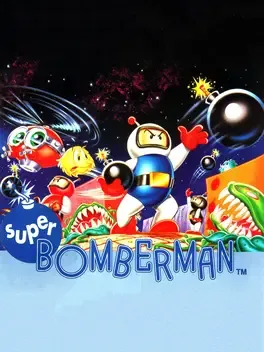
Super Bomberman
Introduction
In the early 1990s, the landscape of home console gaming was shifting toward the 16-bit era, and few titles captured the spirit of pick-up-and-play excitement quite like Super Bomberman. Released in 1993, this title marked the debut of Hudson Soft’s iconic explosive mascot on the Super Nintendo Entertainment System (SNES). While the series had already found success on the NES and the PC Engine, this iteration propelled the franchise into a new dimension of popularity. Known in its home country as スーパーボンバーマン, the game became an instant classic, primarily due to its chaotic multiplayer mode and refined mechanics. It wasn't just another sequel; it was a technical milestone, serving as the first game to support four-player simultaneous action on the SNES, forever changing how friends gathered around the television.
Story & Setting
While the series is best known for its multiplayer mayhem, Super Bomberman features a charming and surprisingly structured single-player campaign. The story unfolds in the peaceful enclave of Peace Town, where our hero, White Bomberman, resides. The tranquility is shattered when the villainous Carat Diamond and his mechanical accomplice, Dr. Mook, hatch a plan to steal Bomberman’s special abilities. They create a robotic doppelgänger known as Black Bomberman to do their bidding. However, after Black Bomberman is defeated and realizes he has been used, he joins forces with White Bomberman. Together, they journey to Diamond City—a high-tech, mechanical metropolis—to infiltrate Diamond Tower. Their mission is to stop Carat Diamond’s robot tournament and prevent him from using his advanced technology to conquer the world. The setting transitions from lush forests and urban construction sites to the sterile, trap-filled corridors of the Diamond Tower, providing a diverse backdrop for the explosive action.
Gameplay
The core gameplay of Super Bomberman remains faithful to the series' roots while adding layers of 16-bit polish. Players navigate a series of top-down, grid-based stages filled with destructible soft blocks and indestructible hard blocks. The primary objective is to place bombs to clear paths, eliminate enemies, and uncover the exit. The complexity arises from the power-ups hidden within the blocks. Items like the "Fire" increase blast radius, while the "Bomb" power-up allows players to drop multiple explosives at once. More advanced items include the Kick, which lets players slide bombs across the screen, and the Glove, which allows them to toss bombs over walls.
The single-player mode consists of six distinct worlds, each culminating in a massive boss fight that requires specific patterns and strategies to overcome. However, the crown jewel of Super Bomberman is its Battle Mode. For the first time on the SNES, up to four players could compete in a last-man-standing arena. This mode introduced a level of social competition that few games could match, where a single misplaced bomb or a perfectly timed kick could turn the tide of a match in seconds.
This game was released on several platforms, including the Super Famicom in Japan and the Super Nintendo Entertainment System in North America and Europe.
Legacy
The legacy of Super Bomberman is inextricably linked to the evolution of local multiplayer. By being the first four-player game on the SNES, it established the "party game" genre years before titles like Mario Party existed. Its success led to four direct sequels on the Super Famicom in Japan, each building on the foundation laid by the original. The game is often cited by critics as one of the best titles in the SNES library, praised for its perfect balance of simplicity and depth. Even today, modern entries in the series continue to use the template established by this 1993 classic. The "Battle Mode" formula proved so timeless that it has remained virtually unchanged for decades, proving that great game design transcends hardware generations.
Fun Facts
- The Multitap Connection: Because the SNES only had two controller ports, Super Bomberman was often sold in a bundle with the "Super Multitap" peripheral in North America, an adapter that allowed four controllers to be plugged in at once.
- Regional Differences: While the core game is the same, the Japanese version, スーパーボンバーマン, featured slightly different box art that showcased the characters in a more traditional anime style compared to the western releases.
- A Heroic Duo: This game is notable for being one of the first times Black Bomberman played the role of a protagonist/ally rather than a primary antagonist.
- Hidden Stages: The game features secret battle arenas that can only be accessed via passwords, providing even more variety for seasoned players.