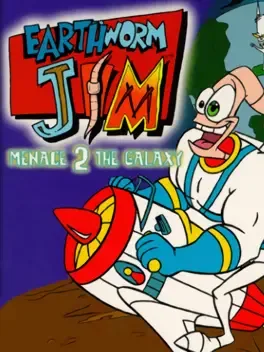
Earthworm Jim: Menace 2 the Galaxy
Introduction
In the late 1990s, the platforming genre was undergoing a massive shift from 2D pixels to 3D polygons. However, some of the industry's most beloved mascots continued to thrive in the palm of our hands. Earthworm Jim, the annelid-turned-superhero with a penchant for high-octane weaponry and surreal humor, made a striking return in Earthworm Jim: Menace 2 the Galaxy. Developed by David A. Palmer Productions, this title served as the second dedicated Game Boy Color adventure for the character. It brought a heavy dose of mayhem and destruction to Nintendo’s handheld, offering fans a portable way to experience the weird and wonderful universe that Jim inhabits. While many mascot games were struggling to find their footing during this era, Jim blasted onto the scene with his signature blaster and a gallery of bizarre enemies.
Story & Setting
The narrative of Earthworm Jim: Menace 2 the Galaxy follows a familiar but chaotic path. The primary antagonist this time is Evil Jim, the dark and nefarious doppelgänger of our hero. Evil Jim has successfully stolen the Great Cup of Health and is using its power to plunge the galaxy into total disarray. To restore order and reclaim the cup, Jim must navigate through 12 bizarre stages that span across the cosmos. The setting is pure Earthworm Jim—filled with the wry humor and absurd environments that define the series. You will find yourself traversing everything from mechanical industrial zones to biological landscapes that defy logic. The world-building leans heavily into the strange, ensuring that every level feels like a fever dream pulled straight from a Saturday morning cartoon.
Gameplay
At its core, Earthworm Jim: Menace 2 the Galaxy is a one-player action-platformer that emphasizes exploration and item collection. Unlike the more linear progression of the 16-bit originals, this handheld entry requires players to collect a specific number of items within its 12 non-linear stages to advance. To help Jim survive the various hazards and enemies, players can utilize four different weapon types. These power-ups are essential for "toasting" foes that block your path. Jim’s classic moves are all here: he can use his own body as a whip to swing from hooks, jump across precarious platforms, and utilize his famous "pocket rocket" to fly through specific segments of the levels. The gameplay loop is a mix of frantic shooting and careful navigation, requiring players to master Jim’s unique physics to uncover every secret hidden within the bizarre stage designs.
This title was developed specifically for the handheld market during the height of the Game Boy Color's popularity. It was designed to be widely accessible while taking advantage of newer hardware features.
Legacy
The legacy of Earthworm Jim: Menace 2 the Galaxy is often debated among series purists. Because it was developed without the direct involvement of the original Shiny Entertainment team, it features a distinct shift in gameplay style compared to the SNES and Genesis classics. Critics at the time praised the game for its technical performance on the Game Boy Color, particularly its vibrant colors and detailed sprites. However, some fans found the collect-a-thon requirements to be a departure from the fast-paced action they expected. Despite this, the game remains a significant part of the franchise's history as it represents one of the final major releases in Jim's original run. It stands as a testament to the character's enduring popularity and the versatility of the Earthworm Jim IP across different hardware generations.
Fun Facts
- Although the game is compatible with the original Game Boy systems, playing it on a Game Boy Color unlocks a special exclusive level that cannot be accessed otherwise.
- The game was published by Crave Entertainment, a company known for bringing many unique console titles to the handheld market during that era.
- Despite the trend of localized title changes in the 90s, this game is known globally only as Earthworm Jim: Menace 2 the Galaxy, with no alternative names used in different regions.
- The game utilizes a password system to save progress, a common feature for handheld titles of its time to ensure players could pick up where they left off without a battery backup.