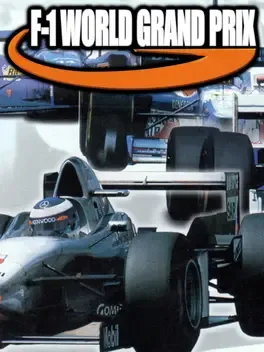
F-1 World Grand Prix
Table of Contents
Introduction
Released during the golden era of 64-bit racing titles, F-1 World Grand Prix emerged as a technical powerhouse that defined the simulation sub-genre for its generation. Often remembered by fans and collectors by its alternative name, F1 World Grand Prix , the title was developed by Paradigm Simulation and published by Video System. At a time when arcade-style racers dominated the market, this game dared to offer a deep, authentic recreation of the 1997 FIA Formula One World Championship. Its arrival on the Nintendo 64 was particularly significant, as it pushed the hardware to its absolute limits, delivering smooth frame rates and high-fidelity textures that were virtually unrivaled in 1998. Whether you were a die-hard petrolhead or a casual gamer looking for a high-speed thrill, this title offered a level of polish and realism that set a new gold standard for sports simulations.
Story & Setting
The "story" of F-1 World Grand Prix is a digital preservation of the 1997 Formula One season, a year filled with intense rivalry and technological evolution. The setting spans the globe, from the sun-drenched tarmac of Interlagos in Brazil to the legendary curves of Suzuka in Japan. The game features the official roster of teams and drivers from that specific year, including the dominant Ferrari, Benetton, and McLaren teams. Notably, due to licensing complexities, the reigning champion Jacques Villeneuve is represented as 'Driver Williams,' adding a unique historical footnote to the experience. The atmosphere is thick with the tension of professional motorsport, capturing a specific window in time when V10 engines screamed across the world's most iconic circuits. The game meticulously recreates all 17 tracks of the 1997 calendar, ensuring that the setting is as accurate as the technology of the time allowed.
Gameplay
The gameplay of F-1 World Grand Prix is built on a foundation of mechanical depth and variety. It offers five distinct modes that cater to different styles of play. The centerpiece is the Grand Prix mode, which provides a full course-by-course simulation of the 1997 season, complete with practice sessions, qualifying rounds, and full-length races. For those seeking immediate action, the Exhibition mode allows for a quick single race with adjustable parameters. Time Trial mode serves the purists, challenging them to master every corner and perfect their racing line against a ghost car.
One of the most praised features is the Challenge mode. This innovative addition places players into specific, real-world scenarios from the 1997 season. You might find yourself tasked with securing an improbable victory as Damon Hill at the 1997 Hungarian Grand Prix, or struggling to hold off rivals as David Coulthard in the heat of the Italian Grand Prix. These scenarios required not just speed, but strategic thinking and a deep understanding of car behavior. Beyond the single-player experience, the game includes a robust 2-player split-screen mode, allowing for intense head-to-head competition. The technical side of the gameplay is equally impressive, featuring dynamic weather that could change mid-race, necessitating tactical pit stops and tire changes that could make or break a championship run.
This game was released on several platforms, including the Nintendo 64 and the PlayStation.
Legacy
F-1 World Grand Prix is widely regarded as a landmark title in the history of racing games. It is often cited as the first F1 game to truly bridge the gap between arcade fun and professional-grade simulation. Upon release, it received critical acclaim for its sophisticated physics engine and high-quality visuals, particularly the Nintendo 64 version, which utilized the console's processing power to deliver impressive weather effects and detailed car models. Its legacy is seen in modern racing titles that prioritize historical accuracy and scenario-based challenges. For many gamers who grew up in the late 90s, the title remains the definitive Formula One experience, remembered for its difficulty, its realism, and its faithful representation of a classic era of motorsport.
Fun Facts
- The developer, Paradigm Simulation, was actually a company specializing in professional flight and military simulation software before they entered the gaming market.
- Because the 1997 World Champion Jacques Villeneuve had his own separate video game deal, the developers had to rename him 'Driver Williams' and create a generic helmet design for him.
- The game featured some of the most advanced 'lens flare' and weather effects seen on the Nintendo 64, which were used as a benchmark for the console's capabilities.
- Despite the realistic focus, players could unlock a hidden 'Silver car' by completing certain difficult challenges in the game.
- The 'Challenge' mode was one of the first times a sports game integrated real-life historical broadcast footage cues into the mission objectives.