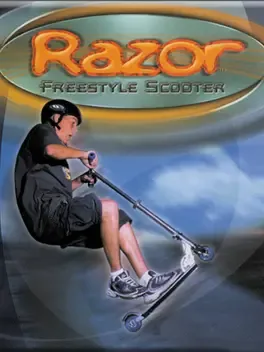
Razor Freestyle Scooter
Introduction
In the late 1990s and early 2000s, extreme sports video games were at the absolute peak of their popularity. While skateboarding and BMX dominated the sales charts, a unique contender emerged to capture the hearts of kids who spent their afternoons on the sidewalk: Razor Freestyle Scooter. Known simply as Freestyle Scooter in several international markets, this title aimed to translate the frantic, nimble energy of the Razor brand into a digital playground. Unlike many of its more grounded competitors that focused strictly on realism, this game blended traditional trick-based mechanics with a surprisingly whimsical, sci-fi narrative, making it a distinct and memorable relic of its era.
Story & Setting
While most extreme sports titles of the time were content with professional circuits or urban exploration, Razor Freestyle Scooter took a sharp turn into the fantastical. The plot centers on a group of young skaters whose peaceful session is interrupted by a crazed, giant robot. This mechanical menace kidnaps your skating buddies and retreats to a massive, high-tech sky fortress. To save your crew, you must navigate through various environments, including city streets and industrial zones, to prove your skills and gather the resources needed for a rescue. The ultimate goal is to infiltrate the robot's sky fortress, completing high-stakes challenges to liberate each captured friend one by one. This narrative framework gives the game a progression style more akin to an action-platformer than a standard sports simulation.
Gameplay
The core loop of Razor Freestyle Scooter follows the established formula of the genre but with a nimble, high-speed twist. Players navigate three large, open-ended environments designed to facilitate verticality and momentum. Because scooters are smaller and more maneuverable than heavy skateboards, the game allows for quick rotations, tight turns, and unique tail-whip animations. Players are tasked with performing wild tricks to rack up points, but the objectives go beyond mere scoring. You must collect scattered scooter wheels to enhance your abilities and find bonus time icons to extend your run.
Progression is strictly tied to specific mission objectives within the three main areas. Once you have cleared the required tasks across these zones, you unlock a special Sky Fortress level. These stages act as the game’s "boss" encounters. Successfully navigating the fortress and meeting its specific trick and collection demands allows you to rescue a new skater. Once rescued, these characters become playable, each featuring their own distinct stats for speed, air, and balance, providing a clear incentive to complete the story.
Razor Freestyle Scooter was widely available across the major home consoles of its generation, ensuring that fans of different hardware could experience the scooting action.
Legacy
The game stands as a digital time capsule of the early 2000s "Razor craze." Developed by Shaba Games—a studio that would later go on to work on the prestigious Tony Hawk's Pro Skater franchise—it offered a more accessible and arcade-like alternative to the hardcore simulation titles of the day. While critics at the time gave it mixed reviews, often pointing to the camera angles or the relatively short length, it remains a cult classic for those who grew up during the height of the scooter's popularity. Its legacy is tied to the broader cultural trend of alternative sports, representing a moment when even the humblest kick-scooter could be the star of a console adventure.
Fun Facts
- The game features several unlockable characters, some of whom were modeled after the real-life professional riders who helped put the Razor brand on the map.
- Because it was developed by Shaba Games, players often notice similarities in the physics engine and UI elements to earlier Activision extreme sports titles.
- The "Sky Fortress" concept was considered a very unusual departure for the genre, leaning more into the platforming tropes of the 32-bit and 64-bit eras than pure sports simulation.
- The Razor brand itself saw a massive global resurgence in sales coinciding with the game’s marketing campaign in the early 2000s.