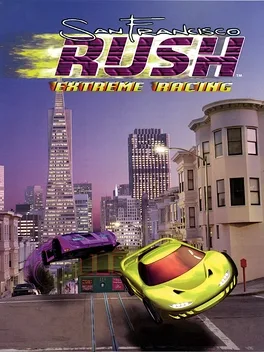
San Francisco Rush: Extreme Racing
Introduction
In the mid-to-late 1990s, the arcade racing scene was defined by high-octane thrills, gravity-defying stunts, and a sense of speed that felt almost reckless. Among the titans of this era, San Francisco Rush: Extreme Racing stood out as a premier example of coin-op excitement successfully transitioning to home consoles. Often referred to simply as "Rush" by its dedicated fan base, the game offered a departure from the rigid realism of simulators, favoring explosive action and a physics engine that rewarded daring maneuvers. Whether you were soaring over the steep hills of California or narrowly avoiding a catastrophic wreck, the title delivered an adrenaline-fueled experience that became a cornerstone of the 64-bit generation.
Story & Setting
While San Francisco Rush: Extreme Racing does not rely on a traditional narrative or cinematic plot, its setting provides all the character necessary for a compelling experience. The game is set in a stylized, high-velocity version of San Francisco, a city uniquely suited for racing due to its iconic, rolling topography. Players navigate through a variety of urban environments, from the foggy stretches of the Golden Gate Bridge to the famously winding curves of Lombard Street. The "story" is essentially the player's rise through the ranks of an underground extreme racing circuit, where the city itself serves as both the playground and the primary antagonist. The atmosphere is one of high-speed urban exploration where every alleyway and hill could lead to a shortcut or a spectacular disaster.
Gameplay
The core mechanics of San Francisco Rush: Extreme Racing are built around its unique, floaty physics and the thrill of verticality. Unlike its contemporaries, the game encouraged players to take flight, with massive jumps being a central feature of every track. The Nintendo 64 version was particularly robust, offering six regular tracks and two hidden tracks that challenged even the most seasoned drivers. To increase longevity, the game allows tracks to be played in reverse or mirrored modes, effectively creating a wide array of navigational challenges.
One of the most praised aspects of the N64 port is the inclusion of collectible hidden keys. These keys are tucked away in secret spots throughout the tracks, requiring players to explore off-road areas and master the physics to reach them. Collecting these keys is the primary method for unlocking hidden vehicles. The game also features a variety of modes, including a Practice Mode for learning track layouts and the high-stakes Death Race mode, where the game ends instantly if the player crashes. With a comprehensive save system for fast times, circuit progress, and key collection, the gameplay loop remains rewarding long after the first race.
This game was released on several platforms, including the Nintendo 64 and the PlayStation, allowing a wide audience to experience its chaotic racing style.
Legacy
The legacy of San Francisco Rush: Extreme Racing is cemented in its role as a pioneer of the stunt-racing subgenre. It was the first entry in what would become the beloved Rush series, spawning sequels like Rush 2: Extreme Racing USA and the neon-soaked San Francisco Rush 2049. Its influence is seen in the way it prioritized fun and environmental interaction over strict mechanical accuracy. For many gamers, it represents the peak of arcade-to-home conversions, proving that the intensity of a cabinet experience could be captured on a home console without losing its soul. It remains a nostalgic favorite for those who remember the distinctive "Extreme!" announcer and the satisfaction of a perfectly landed jump.
Fun Facts
- The arcade version received a major update titled "Rush The Rock: Alcatraz Edition," which added several new tracks, including a grueling race around the famous prison island.
- The game is notorious for its spectacular crash animations; hitting a wall at high speed usually results in the car exploding into several burning pieces, a mechanic that became a series trademark.
- Despite being a racing game, the physics engine was so complex for its time that players discovered they could perform mid-air stunts and flips, which later became an official feature in the sequel.
- The Nintendo 64 version is often considered the superior console port due to its exclusive features, like the hidden keys and the expanded track list, which were absent from other versions.