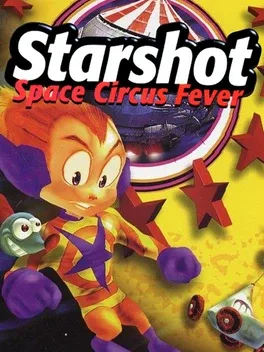
Starshot: Space Circus Fever
Introduction
Story & Setting
Gameplay
Platforms
Legacy
Fun Facts
Introduction
In the late 1990s, the Nintendo 64 was the primary laboratory for the evolution of the 3D platformer. Among the giants of the era, the French developer Infogrames released a title that stood out for its surrealist art style and quirky European charm: Starshot: Space Circus Fever. Known by several regional titles including Starshot : Panique au Space Circus in France, Starshot: Panik im Space Circus in Germany, and Starshot: Paniek in het Space Circus in the Netherlands, the game offered a distinct alternative to the more mainstream mascot platformers. Often referred to simply as Starshot or Space Circus, it attempted to push the boundaries of exploration and character interaction on a console defined by its technical limitations.
Story & Setting
The narrative of the game is as whimsical as its visual style. Players take on the role of Starshot, the star juggler for the legendary Space Circus. The circus is currently in dire straits, facing extinction due to the predatory tactics of a rival organization: the Virtua Circus. This crooked competitor is led by the villainous Wolfgang von Ravel, a man who will stop at nothing to monopolize intergalactic entertainment. To save his home and his friends, Starshot must travel across the cosmos to various planets, gathering the resources and support needed to defeat von Ravel. The journey takes players through a variety of bizarre environments, from the organic depths of the Killer Plant planet to the metallic, industrial landscapes of Iron-Cast, all while interacting with a massive cast of over 300 "cosmical" characters.
Gameplay
Starshot: Space Circus Fever was marketed on its promise of total freedom of movement within rich 3D graphics. Unlike many platformers that restricted the player to jumping and basic melee, Starshot is a versatile protagonist. He can walk, run, talk to NPCs, jump, and swim. One of his most unique abilities is his flight mechanic, which allows for vertical exploration that was quite ambitious for the time. His primary method of offense involves shooting stars; notably, the player can actually control the trajectory of these stars after they are fired, adding a layer of tactical precision to combat and environmental puzzles. The gameplay loop focuses on exploring vast levels, completing objectives for the strange inhabitants of various planets, and overcoming the mechanical minions of the Virtua Circus. The sheer variety of the character roster ensures that the world feels populated and diverse, keeping the player engaged through the sheer unpredictability of their next encounter.
This game was released on several platforms, primarily the Nintendo 64 across various regions.
Legacy
While Starshot did not achieve the same level of commercial success or critical acclaim as Super Mario 64 or Banjo-Kazooie, it has secured a dedicated cult following. It is remembered as a prime example of the "Euro-platformer"—a sub-genre characterized by high difficulty, eccentric character designs, and a focus on atmosphere over mechanical perfection. The game’s attempt to feature 300 unique characters was a significant technical feat for a cartridge-based system. Today, retro gaming enthusiasts revisit the title to experience its unique French artistic sensibilities and its imaginative take on the 3D exploration genre. It remains a fascinating piece of history from an era when 3D game design was still a wild, unexplored frontier.
Fun Facts
- The game features over 300 unique character models, which was a staggering amount for a Nintendo 64 title, often requiring clever memory management from the developers.
- Infogrames, the developer and publisher, was one of the largest European software houses of the era and eventually went on to acquire the Atari brand name.
- The game is known for having a particularly challenging difficulty curve, especially regarding some of its more complex flight and swimming sequences.
- Depending on the region, the game’s cover art and title varied significantly to appeal to different linguistic markets, such as the Dutch Starshot: Paniek in het Space Circus.