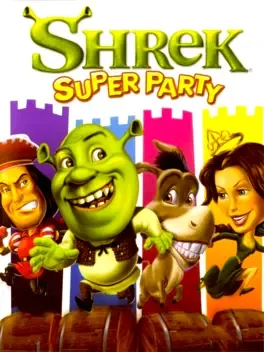
Shrek Super Party
Introduction
Shrek burst onto the scene in 2001, changing the animation landscape forever with its irreverent humor and clever subversion of fairy tale tropes. Naturally, a wave of tie-in media followed to capitalize on the film's massive global success. Shrek Super Party, released in 2002 by Mass Media, aimed to bring the beloved characters and messy charm of the swamp to the competitive multiplayer party genre. For many fans of the green ogre, this title was their first foray into digital board gaming, offering a unique opportunity to settle scores with friends within the whimsical world of Far Far Away. It remains a notable entry in the library of licensed movie games from the early 2000s, blending cinematic nostalgia with social gaming mechanics.
Story & Setting
While party games are rarely celebrated for deep narrative complexity, Shrek Super Party grounds its experience firmly in the recognizable locations of the first film. The premise involves the characters participating in a grand "Super Party" tournament to determine who is the ultimate champion of the land. Players traverse five distinct realms, each based on a key location from the movie: The Keep, The Windmill, The Swamp, The Castle, and The Farm. Each location is rendered with a visual style that captures the movie's specific aesthetic, blending fairy tale charm with the slightly grungy, mud-covered reality of Shrek’s life. The environments act as more than just backdrops; they set the tone for the thematic mini-games that occur within each realm, making players feel as though they are exploring the film's universe.
Gameplay
The core mechanics of Shrek Super Party are heavily influenced by the titans of the genre, most notably the Mario Party series and Pac-Man Fever. It is no coincidence that the game shares DNA with the latter, as both were developed by the experienced team at Mass Media. The game operates as a digital board game where players roll dice to navigate various paths. The primary objective is to collect "Precious Drops"—the game's main currency—by winning mini-games or landing on specific board tiles. The player who amasses the most drops by the end of the round is declared the winner.
The playable roster features six iconic characters: Shrek, Princess Fiona, Donkey, Lord Farquaad, Thelonius, and Monsieur Hood. Each character is brought to life with animations and voice lines that reflect their cinematic counterparts. The mini-games are the heart of the experience, offering over 30 different challenges that test players' reflexes, timing, and strategy. These games vary from physics-based platforming in the Keep to frantic button-mashing contests in the Farm. The game supports up to four players simultaneously, emphasizing the chaotic and social nature of the "couch co-op" era of gaming, though AI players can fill in empty slots.
This game was released on the major sixth-generation consoles of the early 2000s, providing broad access to the Shrek experience across multiple hardware ecosystems.
Legacy
Upon its release, Shrek Super Party received a mixed critical reception, with many reviewers pointing out its mechanical similarities to other established party games. However, for a generation of PlayStation 2 and Xbox owners who did not have access to Nintendo's exclusive franchises, Shrek Super Party became a staple of sleepovers and family gatherings. Over the years, the game has gained a cult status, bolstered by the massive "Shrek" internet subculture that celebrates every aspect of the franchise. It is remembered today as a fun, albeit derivative, piece of gaming history that captured the spirit of one of the most popular film series of all time, serving as a nostalgic time capsule for early 2000s gaming.
Fun Facts
- The development team at Mass Media utilized several assets and engine elements from their previous project, Pac-Man Fever, which accounts for the strong gameplay parallels between the two titles.
- The game features deep-cut characters like Thelonius (Lord Farquaad’s silent executioner) and Monsieur Hood, who have relatively small roles in the films but are fully playable here.
- Despite the launch of the sequel film Shrek 2 in 2004, this 2002 title remains focused entirely on the first film's characters and settings, including the primary antagonist Lord Farquaad.
- Collectors often seek out the game across different platforms to compare the slight graphical variations and frame rate differences between the PlayStation 2, Xbox, and GameCube versions.
- Shrek Super Party is often cited as one of the better-selling licensed party games of its decade due to the immense power of the Shrek brand at the height of its popularity.