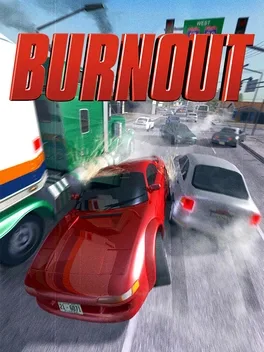
Burnout
Introduction
In the early 2000s, the racing genre was largely divided between the clinical precision of simulations and the kart-based antics of family-friendly titles. Then came Burnout. Developed by Criterion Games, this title stripped away the pretense of professional racing and replaced it with a visceral, high-octane experience that focused on one thing above all else: the thrill of the crash. It wasn't just about crossing the finish line first; it was about how much havoc you could cause and how close to the edge you could drive along the way. Burnout laid the foundation for what would become one of the most beloved arcade racing franchises in gaming history, introducing a generation of players to the addictive nature of high-speed risk-taking and environmental destruction. It was a bold statement that racing could be dangerous, messy, and incredibly fun.
Story & Setting
While many racing games of the era attempted to recreate famous tracks or provide a narrative of a rising star in the professional circuit, Burnout kept its setting grounded yet chaotic. The game takes place across various urban and suburban environments, ranging from congested city streets to sweeping coastal highways. There is no deep plot or complex character development to get in the way of the action. Instead, the 'story' is told through the environments themselves—densely packed traffic, narrow lanes, and intersections that serve as the perfect stage for automotive carnage. Players navigate through these semi-realistic locales, where the every-day commute is transformed into a high-stakes obstacle course. It is a world where every civilian vehicle is a potential hazard or a tool for gaining boost, making every turn a heart-pounding gamble against a wall of yellow cabs and transit buses.
Gameplay
The gameplay of Burnout is defined by its revolutionary Boost Meter. Unlike other games where power-ups are found on the track, here, speed is earned through reckless behavior. To fill the meter, players must drive in the oncoming lane, perform near-misses with traffic, drift through tight corners, and catch air over jumps. Once the meter is full, the player can trigger a 'Burnout,' a sustained burst of incredible speed that requires even more skill to maintain without crashing. However, the game is perhaps most famous for its crashes. When a player inevitably clips a bus or slams into a wall, the action slows down, showcasing the destruction in a cinematic fashion that was groundbreaking for its time. This risk-reward loop created a level of tension rarely seen in racing games, as the player is constantly incentivized to drive as dangerously as possible to stay ahead of the competition. The physics engine was specifically tuned to make every impact feel heavy and significant.
This game was released on several platforms, including the Xbox, PlayStation 2, and the Nintendo GameCube.
Legacy
The legacy of Burnout is impossible to overstate. While the first entry was a more modest affair compared to the absolute chaos of later sequels like Burnout 3: Takedown or the open-world freedom of Burnout Paradise, it established the core DNA of the series. It proved that there was a massive market for arcade racers that prioritized fun and spectacle over realism. Criterion Games used the success of this title to refine their physics engine and damage modeling, which would eventually set the industry standard for destruction in games. Even today, fans look back at the original game as the spark that ignited a new philosophy in game design—one where failure, in the form of a spectacular crash, was just as entertaining as winning. It paved the way for Criterion to eventually take over the Need for Speed franchise, bringing their signature sense of speed to a wider audience.
Fun Facts
Interestingly, during the early stages of its development, the game was referred to by the alternative name 'Shiny Red Car,' a working title that lacks the aggressive punch of the final name but captures the simple aesthetic of the primary vehicle. Additionally, the developers spent an immense amount of time perfecting the sound of the crashes. They recorded actual metal being crunched and glass shattering to ensure the impacts felt heavy and impactful for the player. Another interesting detail is that the game's traffic AI was designed to behave like real drivers, which means they don't always react predictably to the player's high-speed maneuvers, adding an extra layer of difficulty and realism to the urban chaos.