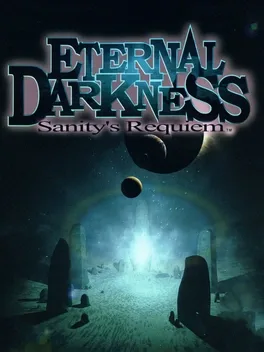
Eternal Darkness: Sanity's Requiem
Introduction
In the landscape of early 2000s gaming, few titles managed to leave as indelible a mark on the horror genre as Eternal Darkness: Sanity's Requiem. Released in 2002 for the Nintendo GameCube, this psychological horror action-adventure was a bold departure from Nintendo’s typical family-friendly image. Often referred to by fans simply as Eternal Darkness or ED, the game was developed by Silicon Knights and introduced a layer of psychological complexity that was largely unprecedented at the time. Instead of relying solely on jump scares or resource management, it targeted the player's own perception of reality, creating an experience that remains a benchmark for atmospheric storytelling.
Story & Setting
The narrative of Eternal Darkness is an ambitious, sprawling epic that spans over two millennia. The story begins in modern-day Rhode Island with Alexandra Roivas, who is investigating the brutal and mysterious murder of her grandfather at his sprawling estate. Her discovery of the "Tome of Eternal Darkness" serves as the gateway to a series of interlocking tales. Players do not just control Alexandra; they step into the shoes of twelve different protagonists across various historical eras.
The setting shifts dynamically, taking players from the expansionist era of Ancient Rome and the high-stakes intrigue of Persia to the battlefields of the Middle East and the chilling atmosphere of 20th-century Europe. These characters—ranging from Roman centurions to colonial doctors and modern firefighters—are all bound by their struggle against the "Ancients," powerful malevolent forces seeking to manifest in our world. The narrative successfully weaves together cosmic horror and historical fiction, making the world feel ancient, interconnected, and deeply perilous.
Gameplay
At its core, ED is an action-adventure game that blends exploration, third-person combat, and intricate puzzle-solving. One of its most distinctive features is the era-appropriate weaponry. Depending on the chapter, players might defend themselves with a gladius or a bastard sword, or switch to more modern tools like flintlock pistols and heavy-duty shotguns. The combat is tactical, allowing players to target specific limbs of enemies to disable them.
Complementing the physical combat is an involved Magick system. This system requires players to collect and combine ancient runes to craft spells. These spells are categorized by alignments—strength, spirit, or mind—and can be used to heal the character, dispel illusions, or launch devastating magical attacks.
However, the most famous mechanic is the Sanity system. Every character has a Sanity meter that depletes whenever they are spotted by a monster. As the meter drops, the world begins to distort. Hallucinations plague the character: walls may appear to bleed, voices whisper from the shadows, and the camera angles become increasingly disoriented. Some effects even break the fourth wall, mimicking hardware failures or system errors to unsettle the player directly. Sanity can only be restored through careful play, such as performing brutal finishing moves on downed enemies or using specific spells.
This game was released as a prestigious exclusive for the Nintendo GameCube, showcasing the console's ability to handle mature and technically demanding software across all major global markets.
Legacy
Despite not being a massive commercial blockbuster upon its initial release, Eternal Darkness: Sanity's Requiem earned widespread critical acclaim and has since achieved legendary cult status. It is frequently cited in lists of the greatest horror games ever made, primarily due to its innovative Sanity effects and its sophisticated approach to narrative structure. Its influence can be seen in many modern horror titles that experiment with player perception and psychological tension. For many, it remains the pinnacle of GameCube-era innovation, representing a time when experimental game design and high-budget production intersected perfectly.
Fun Facts
- Nintendo famously filed and held a patent for the "Sanity System" and its various psychological effects for many years after the game's release.
- The game was originally in development for the Nintendo 64 before being moved to the more powerful GameCube hardware, which allowed for more complex visual hallucinations.
- Many of the Sanity effects were designed to trick the player into thinking their television or console was malfunctioning, such as displaying a fake "MUTE" icon or pretending to delete save files.
- The game features multiple endings based on which "Ancient" deity the player chooses to oppose during the first chapter, encouraging multiple playthroughs.