Geist
Introduction
Story & Setting
Gameplay
Platforms
Legacy
Fun Facts
Introduction
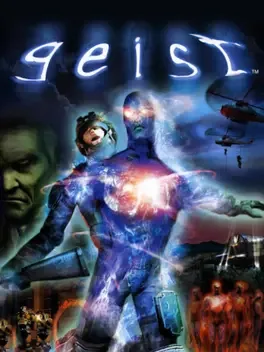
Geist stands as one of the most ambitious and experimental titles to ever grace the Nintendo GameCube library. Developed by n-Space and published by Nintendo, it attempted to fuse the first-person shooter genre with deep, environmental puzzle-solving and a supernatural narrative. For many players, the game is also remembered by its development title, Geist: Ethereal, which hinted at the spectral journey players would undertake. Unlike the standard shooters of the mid-2000s, Geist focused on the concept of disembodiment, forcing players to think not just as a soldier, but as a phantom capable of manipulating the world from the outside in. It was a bold attempt by Nintendo to expand its mature-rated library, providing a dark, atmospheric experience that challenged traditional gameplay conventions while offering a mechanic rarely seen in the genre.
Story & Setting
The narrative of Geist is centered on John Raimi, a civilian scientist specializing in chemical and biological threats. Raimi is embedded with a specialized military team tasked with investigating the Volks Corporation, a massive and shadowy conglomerate suspected of developing dangerous technologies. However, the mission goes horribly wrong. Raimi is captured and subjected to a ghastly experiment that utilizes a specialized machine to rip his spirit from his physical body. This traumatic event leaves Raimi as a spectral entity, trapped within the cold, clinical halls of the Volks Corporation compound. The setting itself is a character, ranging from high-tech laboratories and industrial zones to more sinister, occult-influenced chambers hidden deep within the facility. As Raimi, you are forced to explore this environment to uncover the dark secrets of Alexander Volks and find a way to return your soul to your physical form before your essence fades forever.
Gameplay
The gameplay of Geist is a unique blend of stealth, puzzle-solving, and action. Because you are a ghost, you cannot physically hold a gun or open a door in your natural state. Instead, you must employ your hair-raising power of possession. To inhabit a human host, you must first lower their mental resistance. This is achieved through a clever fear mechanic: by manipulating objects in the environment—making a locker rattle, turning on a faucet unexpectedly, or causing a computer to spark—you can terrify NPCs. Once their aura turns from blue to yellow and finally to red, you can dive into their bodies and take full control.
Possession isn't limited to humans. Players can inhabit animals, such as rats to navigate vents or dogs to distract guards. Even more interesting is the possession of inanimate objects. You might inhabit a security camera to scout ahead, a mechanical crane to clear a path, or even a simple mop bucket to cause a slip-and-fall. Each possession offers a new perspective or a specific utility required to solve the game’s many environmental puzzles. When in control of a soldier, the game transitions into a traditional first-person shooter, but the player must always be mindful of their host’s mortality. If your host dies, you are ejected back into your spectral form, where your spiritual energy slowly drains unless you find a new vessel quickly.
This game was primarily released as a flagship exclusive for the Nintendo GameCube, seeing distribution in both NTSC and PAL regions during the mid-2000s.
Legacy
Geist has earned its place as a cult classic within the GameCube’s diverse library. While it received a mixed critical reception upon release—with some critics finding the shooting mechanics less polished than contemporaries like Halo—it was widely praised for its innovative possession mechanics and dark atmosphere. It remains a fascinating example of Nintendo’s willingness to experiment with third-party developers to create unique, M-rated content during the sixth console generation. Today, it is remembered fondly by fans for its creative puzzles and its distinct multiplayer mode, which allowed players to possess each other in a frantic battle for control. It serves as a reminder of an era when console exclusives were often defined by truly experimental gameplay loops that took risks with established genres.
Fun Facts
- Geist was first revealed at E3 2002 under the title Geist: Ethereal, and the game underwent significant design changes during its lengthy four-year development cycle.
- The game features a robust multiplayer mode where players can compete in modes like 'Possession Deathmatch,' where you fight to control the most powerful hosts on the map.
- The developer, n-Space, was known for their work on various handheld titles, but Geist was one of their most significant and technically demanding console undertakings.
- During development, the team spent a significant amount of time refining the 'spectral vision' effect to ensure players felt they were truly seeing the world through the eyes of a ghost, complete with distorted audio and visuals.