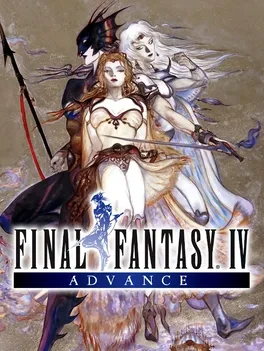
Final Fantasy IV Advance
Introduction
Originally released for the Super Nintendo as Final Fantasy II in North America, Final Fantasy IV is often cited as the game that revolutionized the JRPG genre with its heavy focus on character-driven narrative. However, it wasn't until the release of Final Fantasy IV Advance (also known as FFIV Advance) for the Game Boy Advance that many fans felt they received the definitive 2D version of this masterpiece. This handheld port took the foundation laid by the original FF4 and the later WonderSwan Color version, enhancing it with new content, a cleaner translation, and technical refinements that breathed new life into the journey of Cecil Harvey. Whether you refer to it as FFIV, FF4 Advance, or Final Fantasy 4, this entry remains a cornerstone of the franchise's history.
Story & Setting
The narrative of Final Fantasy IV follows Cecil, the captain of the Red Wings, an elite airship fleet from the Kingdom of Baron. After questioning his King's increasingly cruel orders to seize magical crystals from peaceful nations, Cecil is stripped of his rank and sent on a quest of supposed redemption. The story is a grand epic of betrayal, love, and sacrifice that spans the Earth, the Underworld, and even the Moon. Along the way, Cecil must cast aside his dark past to become a Paladin. The characters he meets—the loyal dragoon Kain, the kind-hearted white mage Rosa, and the wise sage Tellah—are icons of the series. This specific version, Final Fantasy 4 Advance, benefits from a script re-translation that is much more faithful to the original Japanese intent than the 1991 English release, making the emotional beats hit harder for a modern audience.
Gameplay
At its core, FF4 introduced the Active Time Battle (ATB) system, a mechanic that added a layer of real-time tension to traditional turn-based combat. Final Fantasy 4 Advance retains this classic feel while introducing several significant quality-of-life improvements. One of the most praised additions is the ability to switch party members toward the end of the game, a feature not present in the original SNES version. This allows players to bring favorites like Yang, Edward, or Palom and Porom into the final dungeon.
Furthermore, FFIV Advance increases the difficulty to provide a fresh challenge for veterans. It introduces the "Cave of Trials" and the massive "Lunar Ruins" dungeon, featuring fifty floors of randomized challenges and boss rematches. New items and ultimate weapons were added to reward those who brave these trials. To cater to the handheld format, the developers also included a Quicksave feature, allowing players to save their progress anywhere and resume later, though the file is deleted once loaded.
This game was released on several platforms, allowing fans to enjoy the enhanced 2D experience on both portable and home systems.
Legacy
The legacy of FFIV is undeniable, but Final Fantasy IV Advance holds a special place in that history as the bridge between the classic era and the modern era of remakes. It proved that the 2D sprites of the 16-bit era still had immense charm and commercial viability in the 2000s. Its success paved the way for the GBA ports of Final Fantasy V and VI, creating a trilogy of "Advance" titles that are still highly sought after by collectors today. The additions made in this version, particularly the bonus dungeons and party swapping, influenced later remakes including the 3D version and the Pixel Remasters.
Fun Facts
- Final Fantasy IV Advance was actually built upon the engine and assets of the WonderSwan Color version, which had previously only been released in Japan.
- This version added beautiful character portraits in text boxes during dialogue, a feature that helped convey emotion better than the sprites alone.
- The North American release of FF4 Advance fixed several bugs found in the initial Japanese GBA release, such as the "ATB glitch" that caused turn-order inconsistencies.
- Despite being part of the same series, this was the first time many Western players were able to experience the "true" difficulty of the game compared to the simplified "Easy Type" version released on the SNES.