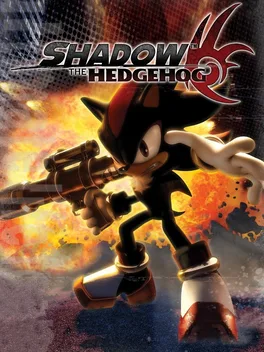
Shadow the Hedgehog
Introduction
Shadow the Hedgehog, released in 2005 by SEGA and developed by Sonic Team, represented one of the most daring and controversial departures in the history of the Sonic the Hedgehog franchise. While the series was traditionally associated with bright landscapes, high-speed platforming, and a lighthearted tone, this spin-off took a sharp turn into "edgy" territory. By placing the focus on Sonic's mysterious and brooding rival, the game introduced elements previously unseen in the series, including third-person shooter mechanics and a branching morality system. As a character study of a fan-favorite anti-hero, it sought to bridge the gap between the platforming roots of the franchise and the gritty action games popular in the mid-2000s.
Story & Setting
The narrative follows Shadow, the "Ultimate Life Form" created by Professor Gerald Robotnik aboard the Space Colony ARK. Following the events of Sonic Adventure 2 and Sonic Heroes, Shadow is still suffering from amnesia, haunted by fragmented memories of a girl named Maria and a violent past he cannot fully grasp. Known in Japan as Shadō za Hejjihoggu シャドウ・ザ・ヘッジホッグ, the game begins as a terrifying alien race known as the Black Arms descends upon the planet. Their leader, the menacing Black Doom, appears before Shadow and claims they once had a pact, promising to reveal the truth of Shadow’s origin in exchange for the seven Chaos Emeralds.
This invasion forces Shadow into a complex moral conflict. The world is in peril as various factions—including the Earth's G.U.N. military forces, Sonic and his friends, and the villainous Dr. Eggman—all make a play for the Chaos Emeralds. Shadow is caught in the middle, and his journey takes him through war-torn cities, digital cyberspace, and ancient ruins as he decides whether to save the world, conquer it, or simply discover the truth of his own existence.
Gameplay
Shadow the Hedgehog retains the core 3D platforming mechanics seen in the Sonic Adventure titles but expands the toolkit significantly. For the first time, players can utilize an arsenal of firearms, ranging from standard pistols and submachine guns to alien-tech energy blasters and heavy rocket launchers. Beyond weaponry, Shadow can interact with his environment by wielding objects like street signs or poles as melee weapons and piloting various vehicles, including military SUVs, motorcycles, and organic alien crafts. These additions were designed to give the gameplay a more tactical and aggressive feel compared to Sonic’s speed-centric levels.
Central to the experience is the branching mission structure. Each of the game's levels features up to three different objectives: Hero, Dark, or Normal. For instance, a Hero mission might involve helping Sonic destroy alien generators, while a Dark mission might require Shadow to assassinate G.U.N. soldiers. Completing a specific mission type fills one of two gauges: the Hero Gauge or the Dark Gauge. Once full, Shadow can trigger "Chaos Control" to warp through levels at high speeds or "Chaos Blast" to unleash a massive explosion. The path the player chooses determines which of the 326 possible level sequences they will follow, eventually leading to one of ten unique endings. Only by unlocking all endings can the player access the final "Last Story" that concludes Shadow's character arc.
This game was released on several major home consoles of its era, ensuring that fans across different hardware ecosystems could experience Shadow's dark journey.
Legacy
Shadow the Hedgehog remains a fascinating piece of gaming history, often cited as a prime example of the "darker and edgier" trend of the sixth generation of consoles. While initial reception from critics was mixed due to the jarring addition of guns and the somber tone, the game has maintained a dedicated cult following. It succeeded in cementing Shadow as a standalone protagonist with a depth of backstory that few other characters in the Sonic universe possess. Today, it is remembered for its ambitious branching narrative and its bold attempt to evolve the franchise's formula. Shadow's popularity remains high, and his characterization in this title continues to influence his appearances in modern media, including the Sonic the Hedgehog cinematic universe.
Fun Facts
- The game was the first in the Sonic franchise to receive an E10+ rating from the ESRB, specifically due to the use of mild profanity and fantasy violence.
- Despite the guns, Shadow can still use his iconic Homing Attack and Spin Dash to traverse levels.
- The game's theme song, "I Am... All of Me," was performed by the hard rock band Crush 40, who are legendary among Sonic fans for their high-energy soundtracks.
- There are exactly 326 unique paths through the game, providing immense replay value for completionists.