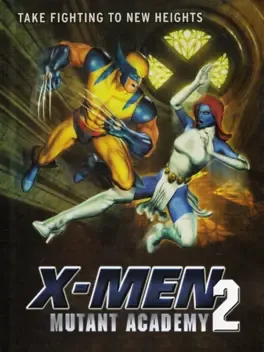
X-Men: Mutant Academy 2
Introduction
Story & Setting
Gameplay
Platforms
Legacy
Fun Facts
Introduction
At the turn of the millennium, Marvel’s X-Men were at the peak of their cultural resurgence, fueled by a hit animated series and a groundbreaking live-action film. Among the digital treasures that emerged during this era was X-Men: Mutant Academy 2, a high-octane 3D fighting game developed by Paradox Development and published by Activision for the original PlayStation. Building significantly upon the foundations laid by its predecessor, this sequel offered fans a chance to take control of their favorite mutants in a gritty, competitive arena. It remains a beloved title for retro gaming enthusiasts and comic book fans alike, successfully bridging the gap between classic comic book lore and the sleek cinematic aesthetic that was beginning to dominate the early 2000s.
Story & Setting
While X-Men: Mutant Academy 2 does not focus on a single, linear narrative, it is deeply rooted in the rich tapestry of the Marvel universe. The game functions as a series of high-stakes training sessions and confrontations taking place within the walls of the Xavier Institute for Higher Learning and other iconic locations. The roster is divided between the heroic X-Men and the formidable Brotherhood of Mutants. Players find themselves navigating the ideological conflict between Professor Charles Xavier and Magneto, utilizing the Academy’s advanced training simulations to hone their skills. The setting is further enhanced by the Cerebro mode, which offers a deep dive into the lore, providing players with character biographies and historical context that makes the game feel like a living encyclopedia of mutant history.
Gameplay
The gameplay of X-Men: Mutant Academy 2 is a refined 3D fighting experience that bears a stylistic and mechanical resemblance to contemporaries like Mortal Kombat 4. The mechanics are built around a versatile layout that facilitates complex combos and a variety of signature moves unique to each character’s mutant powers. Whether it is Wolverine’s relentless claw strikes, Storm’s mastery over lightning, or Gambit’s kinetically charged cards, the game does an excellent job of translating comic book abilities into balanced fighting mechanics. One of the standout features is the Super gauge, which allows players to unleash devastating cinematic finishers once fully charged. The sequel also expanded the roster significantly from the first game, adding fan favorites like Nightcrawler, Havok, and Rogue, each with distinct playstyles. Beyond the standard Arcade and Versus modes, the inclusion of the Academy Mode allows players to learn the nuances of each character’s moveset, ensuring that the game is accessible to newcomers while offering significant depth for fighting game veterans.
This game was primarily released on the PlayStation console, catering to both the North American and European markets with NTSC and PAL versions.
Legacy
The legacy of X-Men: Mutant Academy 2 is defined by its role as one of the last truly great fighting games for the original PlayStation. Critics and fans praised the game for its improved visuals, fluid animations, and the substantial increase in content compared to the first title. It proved that the X-Men franchise could sustain a technical 3D fighter without relying solely on 2D sprite-based combat, which had been the industry standard for years prior. The engine developed for this series eventually paved the way for the next generation of X-Men games, specifically X-Men: Next Dimension on the PlayStation 2. Even decades later, it is remembered as a polished, respectful adaptation of the source material that captured the excitement of the mutant conflict and provided a robust competitive experience for fans during a pivotal time for superhero media.
Fun Facts
X-Men: Mutant Academy 2 is packed with secrets and fan service that rewards dedicated players. One of the most famous inclusions is a guest appearance by Marvel’s iconic wall-crawler, Spider-Man, who appears as an unlockable character with his own unique move set. Additionally, the game serves as a digital time capsule for the 2000 X-Men film. By completing specific challenges, players can unlock a treasure trove of behind-the-scenes content, including original concept sketches for the movie, detailed costume designs, and production stills. Another interesting detail is the Cerebro mode, which was one of the most comprehensive digital databases of X-Men history available at the time, providing a level of depth that went far beyond what was expected of a standard fighting game.