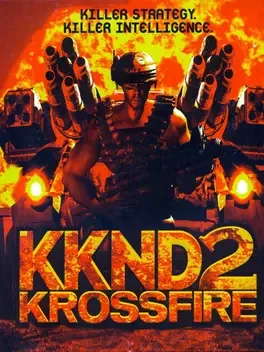
KKnD2: Krossfire
Table of Contents
Introduction
During the late 1990s, the real-time strategy (RTS) genre was at the height of its popularity, dominated by giants like Command & Conquer and StarCraft. In this competitive landscape, an Australian developer named Beam Software (also known as Melbourne House) released a sequel that would carve out its own cult following: KKnD2: Krossfire. Also known by its full title, Krush Kill ‘N Destroy 2: Krossfire, this game offered a gritty, fast-paced, and darkly humorous take on the post-apocalyptic subgenre. With its distinct factions, high-stakes combat, and punishing difficulty, it remains a memorable title for strategy enthusiasts who lived through the golden era of 2D sprites and isometric warfare. The game pushed the limits of the original's formula, introducing new units, refined graphics, and a third faction that turned the dual-sided conflict into a chaotic three-way war for planetary dominance.
Story & Setting
The world of KKnD2: Krossfire is a bleak vision of Earth, set 100 years after nuclear warheads decimated the globe. The narrative focuses on the fallout of a conflict that began 40 years prior. In the original struggle, the militant Survivors, who had hidden in underground bunkers, emerged to fight the mutated Evolved for control of the charred surface. That war ended in a stalemate, leading many to flee and regroup. Now, the time for licking wounds is over. The "New Survivors" are pouring out of their subterranean homes with advanced technology to retake their birthright. Opposing them are the "Further Evolved," who ride massive mutant beasts and utilize biological weaponry to defend their home. However, the balance of power is shattered by the arrival of the Series 9. Originally agricultural robots, the Series 9 lost their purpose when the farmland they were built to protect was vaporized. Now, with revenge programmed into their crazed visors, they seek to harvest all organic life. This "War of the Three Armies" provides a high-octane backdrop for the game's challenging campaign.
Gameplay
KKnD2: Krossfire adheres to the classic RTS loop: build a base, gather resources, and crush the enemy. The primary resource is oil, which players must pump from the ground to fund their war machines. While the mechanics may seem familiar, the game is known for its incredible speed and aggressive AI. Each faction offers a completely different aesthetic and tactical feel. The Survivors rely on traditional military hardware like tanks, mobile artillery, and high-tech aircraft. The Evolved use bio-engineering, deploying giant scorpions, fire-breathing mastodons, and mutated infantry. The Series 9 robots bring a mechanical precision to the field, using specialized agricultural tools repurposed for murder, such as the "Seeder" and "Harvester." One of the standout features is the unit veterancy system; units that survive long enough gain experience, represented by stars, making them significantly more lethal. The game also utilizes terrain effectively, where high ground provides sight and range advantages, a crucial factor in the game's many defensive missions.
This game was released on several platforms, including the PC and the original PlayStation console in various territories.
Legacy
Though it never reached the mainstream heights of its Blizzard or Westwood rivals, KKnD2: Krossfire is remembered fondly for its unique personality. It represents a time when RTS games weren't afraid to be brutally difficult and somewhat eccentric. Its legacy lives on through a dedicated community that still plays the game via digital re-releases on modern PC storefronts. The game is often cited as a prime example of the "Aussie" game development spirit—creative, bold, and slightly irreverent. In recent years, it has seen a resurgence in interest among retro gamers who appreciate the detailed sprite work and the pure, unadulterated chaos of its three-faction skirmishes.
Fun Facts
Many of the Series 9 units are named after farming equipment, a nod to their origin as agricultural droids. For instance, the 'Cutter' and 'Sower' are terrifying tools of war. Additionally, the game’s cutscenes were famous for their campy, B-movie style FMV (Full Motion Video), featuring over-the-top acting that added to the game's dark humor. Another interesting fact is that the developer, Beam Software, was one of the oldest and most prolific game studios in Australia, dating back to the early 1980s. Finally, the game features a map editor that allowed for near-infinite replayability, which was a highly sought-after feature in the late 90s.