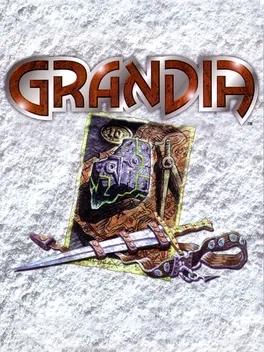
Grandia
Table of Contents
Introduction
Grandia stands as a quintessential masterpiece of the 32-bit era, a role-playing game that perfectly captures the spirit of adventure and discovery. Developed by the legendary studio Game Arts, the team behind the acclaimed Lunar series, Grandia first graced the Sega Saturn in Japan in 1997. Often referred to in its transliterated form as Gurandia or known to Chinese-speaking audiences as 格兰蒂亚, the game was born during a golden age for the genre. Unlike many of its contemporaries that leaned into darker, more cynical narratives, Grandia opted for a bright, optimistic tone that celebrated the joy of exploration. Its transition to the PlayStation in 1999 allowed it to reach a massive global audience, eventually becoming a cult classic that many JRPG enthusiasts consider one of the finest titles ever produced for the platform.
Story & Setting
The narrative of Grandia follows the journey of Justin, a spirited young boy from the bustling port town of Parm. Justin is the son of a legendary adventurer and inherits a mysterious artifact known as the Spirit Stone. Driven by an insatiable curiosity and a desire to see what lies beyond the horizon, Justin sets out to find the lost civilization of Angelou. He is joined by his loyal childhood friend Sue and eventually by Feena, a seasoned and highly skilled adventurer from the town of New Parm.
Their journey takes them across the known world and eventually to the "End of the World," a massive, seemingly infinite stone wall that the inhabitants of the world believe marks the edge of existence. The sense of scale in Grandia is remarkable; climbing the wall is a transformative moment for players, emphasizing the sheer scope of the world Elencia. Along the way, they must contend with the Garlyle Forces, a military organization led by the ambitious General Baal, who seeks the power of the ancients for his own ends. The story is a heartfelt coming-of-age tale that remains resonant decades later.
Gameplay
Grandia is most famous for its revolutionary combat mechanics, which blended turn-based strategy with real-time elements. The heart of the system is the Initiative Point (IP) bar, which tracks the turn order of both allies and enemies. This allows players to strategically time their attacks to "Cancel" or "Counter" an enemy's move before it executes, adding a tactical layer that keeps battles engaging from start to finish.
Beyond combat, the game features a unique character progression system. Instead of simply gaining generic levels, characters improve their proficiency with specific weapons and elemental magic by using them repeatedly in battle. For example, using a sword frequently will unlock new physical techniques, while casting fire spells will increase the character's fire level and eventually unlock advanced fusion spells. Visually, the game utilized a mix of 2D character sprites on fully 3D environments, which players could navigate using a rotatable camera—a significant technical achievement for the time.
This game was released on several platforms, including the Sega Saturn, the original PlayStation, and later digital storefronts for modern Sony consoles.
Legacy
The impact of Grandia on the RPG landscape cannot be overstated. Its battle system was so well-received that it became the foundation for every subsequent entry in the franchise, including Grandia II and III. The game's musical score, composed by the brilliant Noriyuki Iwadare, is often cited as one of the best in gaming history, perfectly capturing the sweeping emotion of a grand journey. While the franchise has seen fewer releases in recent years, the original title remains a benchmark for how to build a world that feels truly alive. Its recent inclusion in HD collections on modern hardware proves that the charm of Justin’s adventure is timeless, continuing to inspire developers who prioritize a sense of wonder in their game design.
Fun Facts
- The game was originally intended for the Sega CD, but development shifted to the Saturn to take advantage of the superior hardware.
- Two Japan-exclusive spin-offs were produced: Grandia: Digital Museum, which allowed players to explore a museum filled with game assets, and Grandia: Parallel Trippers, a handheld title for the Game Boy Color.
- The English localization of the PlayStation version features a distinct voice cast that has become nostalgic for Western fans, though it was quite different from the original Japanese performance.
- Grandia Online, which served as a prequel to the first game, was in development for many years before finally launching and later being discontinued.
- The "End of the World" wall was so large in the game's lore that it took the characters several days to climb it, a feat that players experienced through multiple save points and camp scenes.