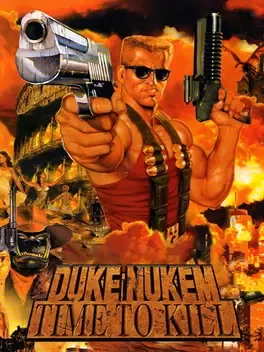
Duke Nukem: Time to Kill
Introduction
When people think of the legendary action hero Duke Nukem, they often recall the fast-paced, first-person carnage of his 1996 masterpiece. However, the King was not content staying in just one perspective. In 1998, developer n-Space and publisher GT Interactive brought the blonde-haired, cigar-chomping protagonist to the Sony PlayStation in Duke Nukem: Time to Kill. This title represented a significant departure for the series, serving as the first entry to utilize a third-person perspective. Known colloquially among the community as DNTTK, this game sought to blend the high-octane shooting the series was known for with the exploration-heavy platforming popularized by contemporary hits like Tomb Raider. By shifting the camera behind Duke's shoulder, the developers were able to introduce a new layer of verticality and environmental interaction that changed the way fans engaged with the franchise.
Story & Setting
The narrative of Duke Nukem: Time to Kill kicks off in typical Duke fashion. While enjoying some leisure time at a lounge in Los Angeles, Duke witnesses a group of alien invaders known as the Draks attempting to alter Earth's history. These time-traveling reptilians aim to erase humanity's future by sabotaging its past. Duke, never one to let an alien threat go unpunished, jumps into a time portal to chase them down. This premise allows for an incredible variety of settings throughout the campaign. Players are whisked away from the neon-soaked streets of modern LA to the sun-scorched deserts of Ancient Egypt, the murky castles of Medieval Europe, and the dusty saloons of the American Old West. Each era is meticulously designed to reflect its historical period while still feeling distinctly "Duke," complete with era-appropriate versions of his classic enemies, like the mutated Pig Cops who haunt every timeline.
Gameplay
Transitioning to a third-person view fundamentally changed the core dynamic of the franchise. In DNTTK, the gameplay is a hybrid of intense gunplay and environmental puzzle-solving. Duke can jump, climb, swim, and hang from ledges—movements that were impossible in his previous 2.5D outings. The controls were heavily influenced by the action-adventure standards of the era, requiring players to navigate precarious platforms and find keys to progress. Of course, the firepower remains a highlight. Duke has access to his trusty M1911 pistol, shotguns, and RPGs, but the time-travel theme introduces unique weapons like the Holy Grenade in the Medieval era or the Gatling Gun in the Old West. A standout feature is the inclusion of a two-player split-screen deathmatch mode, which was a rarity for third-person shooters on the PlayStation at the time, allowing friends to settle scores in dedicated arena levels designed for maximum mayhem.
This game was released exclusively for the Sony PlayStation, taking full advantage of the console's 3D hardware to render its expansive environments and character models across different historical eras.
Legacy
Duke Nukem: Time to Kill holds an important place in the history of the franchise. While some purists were initially skeptical of the perspective shift, the title was a commercial success and received generally positive reviews for its level design and thematic variety. It proved that the character of Duke Nukem was versatile enough to exist outside of the first-person shooter genre. This success led directly to a sequel, Duke Nukem: Land of the Babes, which further refined the third-person mechanics. Even today, fans look back fondly on the game's industrial metal atmosphere and Jon St. John’s iconic voice lines, which cemented Duke's status as the ultimate action hero of the late 90s. The game is often cited as one of the better spin-offs in the series, maintaining the humor and attitude that fans craved.
Fun Facts
Despite the tough-guy persona, Duke changes his outfits to match the time period he is visiting, ranging from a kilt in Scotland to a cowboy outfit in the West. The game contains numerous pop-culture references, including nods to the film Army of Darkness and Back to the Future. Additionally, the acronym DNTTK is still used by speedrunners who compete to find the fastest routes through the game's complex levels. Finally, the opening cinematic features a high-energy performance by the band Fear Factory, who provided a remix of the classic "Grabbag" theme specifically for this release.