Introduction
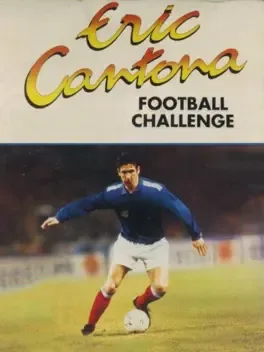
In the early 1990s, the football gaming landscape was a battlefield of shifting pixels and evolving mechanics. Amidst this fierce competition, publishers often sought the midas touch of celebrity endorsements to differentiate their products. Eric Cantona Football Challenge stands as a quintessential example of this era's marketing strategy. Released specifically to capture the French market, the game leveraged the immense charisma and talent of Manchester United's legendary forward, Eric Cantona.
While the title suggests a bespoke experience built from the ground up for "The King," it is actually part of a much larger lineage. The game is the French port of World Soccer '94: Road to Glory, which itself was a refined port of the classic title Striker. By branding the game with Cantona's name, the developers provided a localized flair that resonated deeply with European football fans during a decade where Cantona was arguably the most famous athlete in the sport.
Story & Setting
As a traditional sports simulation, Eric Cantona Football Challenge does not feature a scripted narrative or a fictional world. Instead, the "story" is the one the player creates on the pitch. The setting is the high-stakes world of international football during the mid-90s, a period of transition where the sport was becoming a global commercial juggernaut.
The game places players in the center of the action, tasking them with leading their chosen national team through a series of grueling matches. Whether playing through a friendly exhibition or a full-scale international tournament, the atmosphere is designed to evoke the tension of a stadium crowd. The game captures the zeitgeist of the 1994 World Cup era, providing a digital stage for players to replicate the real-world heroics of their favorite international stars on the "Road to Glory."
Gameplay
Built upon the highly successful Striker engine, the gameplay in Eric Cantona Football Challenge is characterized by its blistering speed and arcade-style accessibility. Unlike the more methodical simulations that would arrive later in the decade, this title focuses on rapid transitions, quick passing, and instinctive shooting.
The visual perspective is a defining feature. Utilizing a pseudo-3D viewpoint that looks down and into the pitch, the game provides a sense of depth and scale that was impressive for its time. This orientation allows for a better view of forward runs and defensive gaps. Players have access to a variety of modes, including league play and knock-out tournaments. The controls are tight and responsive, allowing for complex maneuvers such as headers, volleys, and sliding tackles. Tactical depth is also present, with various formations and strategies available to counter the AI's aggressive playstyle. The game effectively translates the flair and intensity associated with Eric Cantona into a digital format that rewards aggressive, forward-thinking football.
This game was primarily developed to cater to the European market, specifically targeting French-speaking audiences who followed Cantona's career closely. It saw its release on the flagship 16-bit console of the era.
- SUPER NINTENDO ENTERTAINMENT SYSTEM: PAL
Legacy
Eric Cantona Football Challenge holds a unique place in the history of localized gaming. It serves as a reminder of a time when the software market was fragmented by region, leading to fascinating variations of the same core game under different titles. In the United Kingdom and North America, players were enjoying World Soccer '94: Road to Glory or the original Striker, while French players were treated to the Cantona-branded experience.
Historical reception highlights the game's speed as its greatest strength, often cited as one of the fastest football games available on the Super Nintendo. Today, it is remembered as a nostalgic relic of the 90s, representing the peak of Eric Cantona’s cultural influence. It remains a sought-after title for collectors of 16-bit sports games and those interested in the history of celebrity-endorsed software.
Fun Facts
- The game is essentially a localized repackaging of World Soccer '94: Road to Glory, which was itself a port of the original Striker developed by Rage Software.
- Despite the prominent branding, Eric Cantona does not actually appear as a distinct playable character with unique stats; the endorsement was purely for the box art and marketing.
- The game’s engine was known for its technical prowess, pushing the SNES hardware to deliver a high frame rate despite the scaling effects used for the pitch.
- In some regions, the Striker series was so popular that it was ported to almost every major platform of the time, from the Amiga to the Game Gear.
- The use of Cantona was a calculated move by the publisher to compete directly with Electronic Arts’ FIFA series, which was just beginning its dominance in the market.