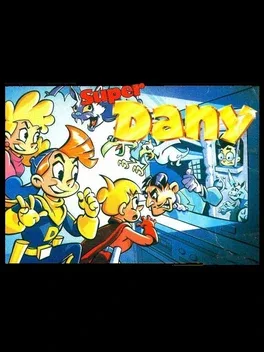
Super Dany
Introduction
In the history of the 16-bit era, there exists a curious subgenre of software known as "advergames"—titles developed specifically to promote a commercial product or brand. Super Dany is one of the more unique examples of this phenomenon, hailing from the French gaming market of the early 1990s. Developed for the Super Nintendo Entertainment System, it was designed to market the "Dany" brand of dairy desserts produced by Danone. While many promotional games of the time were often rushed or lacked depth, Super Dany surprised players with its competent puzzle-platforming mechanics and charming visual style, making it a noteworthy, if obscure, piece of SNES history.
Story & Setting
The narrative of Super Dany is lighthearted and functional, serving mainly to propel the player through its various imaginative worlds. The game follows the adventures of Dany, the cheerful mascot of the chocolate mousse and dairy snack line, along with his group of friends. Together, they must navigate a series of surreal, brightly colored environments that feel like a mix between a Saturday morning cartoon and a fever dream of 90s advertising. The settings range from toy-filled wonderlands to abstract landscapes filled with obstacles, all while maintaining a whimsical atmosphere that was clearly aimed at the younger demographic of the time.
Gameplay
The core of Super Dany lies in its puzzle-platforming mechanics, which are significantly more complex than the average licensed title. The player does not simply control Dany; instead, the game features a character-switching mechanic that is essential for progression. The "Dany Gang" consists of several characters, each possessing a unique special ability.
For example, while Dany is the balanced lead character, his friends provide the muscle or agility needed to bypass specific environmental hazards. One friend might have the strength to push heavy blocks or break through barriers, while another might be smaller and able to reach high platforms or squeeze through tight gaps. Players must constantly evaluate the level layout and switch between characters to solve logistical puzzles—such as standing on a pressure plate with one character to open a door for another. This focus on cooperative mechanics within a single-player framework gives the game a strategic depth that rewards patience and logic over pure reflexes.
This game was released on several platforms, including the Super Nintendo Entertainment System.
- SUPER NINTENDO ENTERTAINMENT SYSTEM: PAL, NTSC-U
Legacy
While Super Dany never achieved international superstardom, it holds a special place in the hearts of European SNES collectors and French retro-gaming enthusiasts. Published by Virgin Interactive, it represents a specific moment in time when large corporations saw video games as a viable medium for long-form brand engagement. Over the years, the game has gained a reputation as a "hidden gem" for those who enjoy character-swapping puzzle games. Because it was largely a regional release, physical copies have become relatively rare, making it a prized item for collectors looking to complete their PAL or NTSC-U libraries. It stands as a testament to the creativity that could be found even in projects born purely from commercial marketing budgets.
Fun Facts
- The game was developed by Cryo Interactive, a French studio that would later become famous for ambitious adventure titles like Dune and Dragon Lore.
- Despite being an advertisement for chocolate mousse, the game is surprisingly difficult, featuring some platforming sections that require pixel-perfect precision.
- Dany’s mascot design was iconic in France during the 90s, appearing in numerous television commercials before making the jump to the Super Nintendo.
- The character-switching mechanic in Super Dany predates similar systems found in more high-profile titles like Donkey Kong Country 3 or The Lost Vikings.