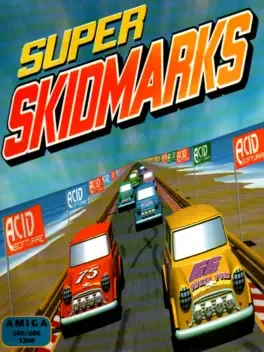
Super Skidmarks
Introduction
In the mid-1990s, the racing genre was split between high-fidelity simulations and the frantic energy of arcade racers. Standing tall among the most beloved titles of this era is Super Skidmarks, a 1995 sequel that refined and expanded the formula established by its predecessor, Skidmarks. Developed by the talented team at Acid Software, the game quickly became a staple for competitive gamers who valued tight controls and chaotic action. Often referred to by fans and industry commentators as Skidmarks 2 or Super Skidmarks 2, this title captured the essence of local multiplayer gaming. It offered a unique blend of technical driving and absurd humor that helped it stand out in a crowded market, ultimately becoming one of the most successful releases for the Amiga and Sega platforms in the United Kingdom.
Story & Setting
Unlike many modern racers that feature deep career modes or cinematic narratives, Super Skidmarks focuses entirely on the thrill of the race itself. The setting is one of diverse environments, where the track layout is the primary protagonist. Players are thrust into a world of isometric speed, navigating a series of circuits that range from traditional dirt tracks to more imaginative and treacherous locales. There is no complex plot involving corporate sponsors or rising stars; the world of Super Skidmarks is one of pure sport, where the only thing that matters is the friction between the tires and the turf. The minimalist approach to story allows the personality of the game—manifested through its quirky vehicle choices and vibrant art style—to shine through, creating a friendly yet intensely competitive atmosphere.
Gameplay
At its core, Super Skidmarks is defined by what the developers described as "minimally realistic" action. Viewed from a classic isometric perspective, the game challenges players to master the art of the drift. The physics engine was carefully tuned to allow for satisfying power slides while maintaining a sense of weight and momentum. What truly set the game apart was its sheer variety and the inclusion of novelty vehicles. While players could race in standard sports cars, they also had the option to pilot caravans or even wheeled cows, adding a layer of surrealism to the high-speed competition.
The game’s true strength, however, was its multiplayer integration. Supporting up to eight players simultaneously, the game utilized a variety of methods to ensure everyone could join in. This included the use of joypad adapters and link systems, making it a pioneer in large-scale local multiplayer on home hardware. Whether racing against the clock or bumping fenders with friends, the gameplay remained fluid and frantic, rewarding players who could navigate the tight turns and elevation changes of the complex tracks.
Super Skidmarks was released across several different hardware platforms, with its roots firmly planted in the Amiga ecosystem before expanding to home consoles.
- SEGA MEGA DRIVE/GENESIS: PAL
Legacy
Super Skidmarks is remembered today as a pinnacle of the 16-bit racing era. Upon its release, it was a massive commercial success, particularly in the UK where it dominated bestseller lists for months. Critics hailed it for its addictive loop and technical prowess, specifically noting how it managed to handle multiple players and complex sprites without sacrificing performance. Its legacy persists in the retro gaming community, where it is often cited as one of the best examples of the isometric racing subgenre. The game’s ability to balance serious competition with lighthearted fun—like the aforementioned wheeled cows—ensured that it remained in the hearts of gamers long after the transition to 3D graphics. It stands as a testament to Acid Software's ability to maximize the potential of the Amiga and Sega hardware.
Fun Facts
- The game is frequently called Skidmarks 2 or Super Skidmarks 2 by the press and fans due to its status as a direct sequel.
- The infamous "wheeled cows" vehicle option became an iconic piece of gaming trivia from the 90s.
- On the Sega Mega Drive, the game was published by Codemasters and utilized their unique J-Cart technology, which featured two extra controller ports built directly into the game cartridge.
- Despite the isometric view, the tracks featured significant elevation changes, including bridges and ramps, which were technologically impressive for the time.
- The game’s multiplayer mode was so popular that it became a standard fixture in gaming tournaments across the UK during the mid-90s.