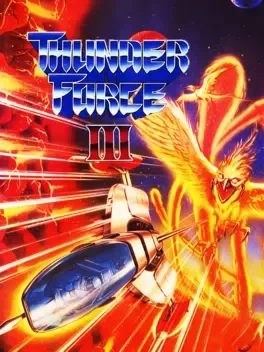
Thunder Force III
Introduction
When gamers think of the golden age of the Sega Genesis, few titles evoke as much adrenaline-fueled nostalgia as Thunder Force III. Developed by the legendary Technosoft and released in 1990, this third chapter in the iconic series redefined what was possible on 16-bit hardware. While its predecessor had experimented with a mix of overhead and side-scrolling stages, Thunder Force III focused exclusively on high-speed horizontal action, setting a standard for the scrolling shooter or "shmup" genre that few contemporaries could match. It was a technical marvel that proved the Sega Genesis was the premier destination for arcade-quality action in the early 90s.
Story & Setting
The narrative picks up where the previous conflict left off, continuing the interstellar war between the Galactic Federation and the tyrannical ORN Empire. The Empire has deployed a sophisticated cloaking system that renders their central base invisible to long-range sensors, making a large-scale fleet assault impossible. To counter this, the Federation deploys the FIRE LEO-03 Styx, a small, highly maneuverable fighter craft designed for precision strikes and infiltration. Players pilot the Styx through a variety of hostile environments across multiple planets—including the volcanic world of Haides and the aquatic depths of Seiren—before finally taking the fight to the heart of the ORN Empire. The setting is a classic sci-fi tapestry of mechanical fortresses and biological horrors.
Gameplay
The core mechanics of Thunder Force III are a masterclass in shooter design. One of the game's standout features is the flexible weapon system. Players start with the standard Twin Shot and Back Fire, but can collect power-ups for five distinct weapons: the wide-reaching Wave, the homing Hunter projectiles, and the powerful, concentrated Lancer. A crucial tactical element is that players can switch between any acquired weapons on the fly. However, losing a life means losing the currently equipped special weapon, adding a layer of risk-reward to every encounter.
Additionally, players can collect "Claw" satellites that rotate around the Styx, providing extra firepower and absorbing certain enemy projectiles. Another unique mechanic is the variable speed control, allowing players to cycle through four different speed settings (from 1% to 100%) to navigate tight corridors or dodge fast-moving bosses. Unlike many shooters of the era that forced a linear path, Thunder Force III allows players to select the order of the first five stages, giving them control over how they tackle the challenge.
This game was released on several platforms, including the Sega Mega Drive and Genesis, providing a flagship experience for Sega owners across Japan, Europe, and the United States.
Beyond its home console roots, the game was retooled as an arcade experience under the name Thunder Force AC in late 1990. This arcade version was eventually ported to the Super Nintendo Entertainment System in 1991, where it was renamed Thunder Spirits, featuring some adjustments to level design and difficulty settings.
Legacy
Thunder Force III is often cited as one of the best shooters of all time. Technosoft's mastery of the Genesis hardware was evident in the game's use of multi-plane parallax scrolling and vibrant color palettes, which were far ahead of their time in 1990. The technical prowess displayed in the "molten" effects and the fast-moving backgrounds helped sell the Sega Genesis as a "blast processing" powerhouse. The soundtrack, composed by Toshiharu Yamanishi and Tomomi Otani, remains a fan favorite for its driving FM-synth rock themes. It solidified the series as a titan of the genre and paved the way for the even more ambitious Thunder Force IV.
Fun Facts
Interestingly, the game is frequently referred to by fans and in some documentation as Thunder Force 3, though the Roman numeral remains the official branding. When the game was adapted into Thunder Spirits for the SNES, many fans noted that while the graphics were comparable, the performance suffered from significant slowdown—a common issue for early SNES ports of high-speed Genesis games. Furthermore, the arcade version, Thunder Force AC, actually removed several stages from the original Genesis version and replaced them with content from Thunder Force II, making it a unique hybrid of the two titles rather than a direct port.