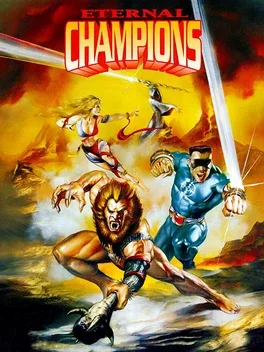
Eternal Champions
Introduction
In the early 1990s, the video game industry was undergoing a seismic shift. Following the monumental success of Street Fighter II in 1991 and Mortal Kombat in 1992, a massive "fighting game mania" gripped the market. Sega, aiming to provide a high-quality exclusive for its Mega Drive and Genesis hardware, decided to create a franchise that could stand toe-to-toe with these arcade giants. Released in 1993, Eternal Champions was Sega's ambitious answer to the craze. Rather than simply imitating its predecessors, the game sought to innovate by offering deeper narrative elements, unique technical mechanics, and a visual style that pushed the 16-bit hardware to its limits. It remains one of the most distinct fighters of its era, remembered for its high difficulty and imaginative world-building.
Story & Setting
The narrative of Eternal Champions is far more complex than the standard tournament-style plots seen in contemporary fighters. The game centers on the Eternal Champion, an omnipotent being who oversees the balance of time. He realizes that history has been skewed because several individuals throughout various eras were killed before they could fulfill their destinies to change the world for the better. To fix the timeline, the Champion summons nine souls from different time periods—ranging from prehistoric times to a dystopian future—moments before their deaths. Each character is fighting for a second chance at life. The winner of the tournament is granted the opportunity to return to their own time and avoid their demise, thereby restoring the proper flow of history and ensuring humanity's survival.
Gameplay
Eternal Champions introduced several features that set it apart from other fighting games of the time. While most games focused on simple button combinations, this title placed a heavy emphasis on an "Inner Strength" meter. This meter governed the use of special moves, meaning players could not simply spam powerful attacks; they had to manage their energy carefully, encouraging a more tactical and defensive approach to combat. The game also featured a diverse roster of fighters who carried weapons and utilized unique projectiles, some of which could be reflected back at the attacker. One of the most significant innovations was the training mode, which used a "Danger Room" concept where players had to survive against lethal robotic traps to sharpen their skills. Furthermore, the game included "Overkills," which were elaborate, stage-specific finishing moves. If a player defeated an opponent at a specific location on the map, the environment itself would execute the loser in a cinematic and often gruesome fashion.
This game was released on several platforms, including the Sega Mega Drive/Genesis and the Nintendo Wii Virtual Console.
Legacy
Although it did not reach the same level of mainstream ubiquity as Street Fighter, Eternal Champions secured a dedicated cult following and is considered a staple of the Sega Genesis library. It was praised for its technical ambition and deep lore, leading to a significantly enhanced sequel on the Sega CD titled Eternal Champions: Challenge from the Dark Side. This sequel expanded the roster and the intensity of the finishing moves. There were plans to continue the series on the Sega Saturn, but these projects were eventually cancelled as Sega shifted focus toward Virtua Fighter. Despite the franchise's premature end, characters like Shadow Yamoto and Larcen Tyler remain iconic figures for retro gaming enthusiasts who appreciate the title's unique blend of science fiction and martial arts.
Fun Facts
- The game's Overkills were so memory-intensive that they required a significant portion of the cartridge's storage space compared to other game assets.
- Mitchell Midknight, the game's vampire character, was not a traditional mythological vampire but rather a victim of a bio-weapon experiment gone wrong.
- The game featured a novel move execution system that attempted to make special attacks feel more intuitive, though it was notoriously difficult to master.
- Eternal Champions was one of the few games at the time to receive a full-fledged marketing campaign that included a line of comic books and action figures.