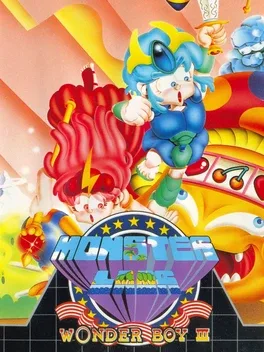
Wonder Boy III: Monster Lair
Introduction
Story & Setting
Gameplay
Platforms
Legacy
Fun Facts
Introduction
Step back into the golden age of arcades with Wonder Boy III: Monster Lair. Released in 1988 by Westone and Sega, this title represents a vibrant and energetic departure from the burgeoning RPG elements seen in its immediate predecessor. While many fans of the series associate the third entry with the non-linear exploration of The Dragon's Trap, Monster Lair: Wonder Boy III offered an entirely different vision. It focused on fast-paced, side-scrolling action that blended platforming with "shmup" (shoot 'em up) mechanics. This game was a celebration of color, sound, and cooperative play, designed to keep players on the edge of their seats as they navigated treacherous environments filled with bizarre creatures.
Story & Setting
The narrative of Wonder Boy III: Monster Lair is simple yet effective, setting the stage for a grand adventure. The story takes place in the once-quiet town of Xenobia, a land that has been suddenly besieged by a relentless horde of monsters. These invaders threaten the peace of the entire realm, and the call for heroes is answered by two brave protagonists: Leo and Priscilla. Armed with the Legendary Weapons, these two must trek through diverse landscapes—from lush forests and volcanic regions to the depths of space—to track down the source of the evil and restore peace to Xenobia. Unlike later entries that focused on complex lore, Monster Lair maintains the whimsical, lighthearted tone characteristic of the early series.
Gameplay
The gameplay of Wonder Boy III: Monster Lair is unique because it is split into two distinct phases within each level. In the first half, players engage in auto-scrolling platforming action. Here, Leo and Priscilla must jump over obstacles and dispatch enemies using projectiles. A crucial mechanic is the "Vitality" bar; unlike traditional health bars, this meter constantly depletes over time. To stay alive, players must collect fruit and items scattered throughout the stage to replenish their energy. This creates a sense of urgency that is rarely seen in standard platformers.
The second half of each stage transitions into a horizontal scrolling shooter. The characters hop onto small flying dragons or use their own magical abilities to navigate the skies. During these segments, players face waves of airborne enemies before finally confronting a massive boss. These bosses often require specific patterns to defeat and provide the "Legendary Weapons" experience promised in the game's premise. The ability to play cooperatively with a second player adds a layer of strategy and fun, as both heroes work together to balance power-ups and cover different areas of the screen.
This game was released on several platforms, bringing the arcade excitement to home consoles across different regions.
Legacy
The legacy of Wonder Boy III: Monster Lair is somewhat overshadowed by its namesake on the Master System, The Dragon's Trap, which was also released as "Wonder Boy III" in many territories. This led to significant confusion among fans for decades. However, within its own right, Monster Lair is remembered as a pinnacle of arcade-style fun. It demonstrated Westone's ability to innovate within the genre, proving that the Wonder Boy franchise could successfully pivot from RPG-lite exploration back to pure action. Its influence can be seen in later "run and gun" games that incorporate health-decay mechanics and hybrid gameplay styles. For many collectors and retro enthusiasts, it remains a beloved "hidden gem" of the 16-bit era.
Fun Facts
- Due to its title, this game is often confused with Wonder Boy III: The Dragon's Trap. In Japan, the confusion was less prevalent as the titles were more distinct.
- The PC Engine/TurboGrafx-CD version featured a highly acclaimed redbook audio soundtrack that became a fan favorite.
- Despite the "III" in the title, it is actually the fourth game released in the series if one counts the original arcade releases.
- The vitality-drain mechanic was designed to ensure arcade players couldn't sit idle, forcing them to spend more coins to continue if they weren't fast enough.