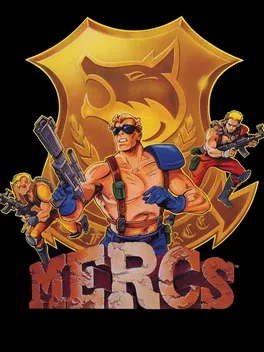
Mercs
Introduction
In the golden age of the arcade, few genres commanded as much attention as the top-down run-and-gun shooter. Capcom, a titan of the era, delivered a masterclass in action with the 1990 release of Mercs. As the direct successor to the legendary 1985 hit Commando, Mercs—also known as Wolf of the Battlefield: Mercs—took the foundation laid by its predecessor and expanded it with larger-than-life set pieces, cooperative play, and a significantly more detailed world. Whether players knew it as Senjou No Ookami II in Japan or through other localized variations, the game quickly became a staple for action enthusiasts who craved high-octane combat and tactical weapon management. Throughout various development stages and international releases, the title has even been associated with names like Mercenaries Inc. and Mercenaries 3, reflecting its multifaceted identity in the retro gaming market.
Story & Setting
The narrative of Mercs is a classic piece of 1990s action cinema logic. Players take control of a member of the "Wolf Force," a covert counter-terrorist team of elite mercenaries. The mission is high-stakes: a former U.S. President has been kidnapped by a group of rebels in the fictional African country of Zutula. This setting was clearly inspired by the geopolitical climate of the time, bearing a striking resemblance to the apartheid regime in South Africa. The journey through Zutula is arduous, requiring the Wolf Force to fight their way through dense jungles, fortified bases, and urban war zones. The story culminates in a dramatic final showdown to rescue the President from the massive Hercules Transport, a climax that remains one of the most memorable sequences in early 90s gaming, blending political intrigue with pure explosive action.
Gameplay
At its core, Mercs is an 8-way directional shooter that emphasizes constant movement and overwhelming firepower. The game consists of six main levels, each ending with a formidable boss battle, followed by the intense rescue mission on the Hercules Transport. To survive the onslaught of Zutulan rebels, players have access to a versatile arsenal. The standard machine gun can be upgraded, but the true power lies in special pickups like shot guns for wide spreads, flame throwers for close-quarters crowd control, and grenade launchers for heavy damage. A standout feature for the time was the inclusion of pilotable vehicles in several missions, allowing players to turn the tide of battle with armored support. The arcade version supported up to three players simultaneously, while most home ports focused on a refined single-player experience. Whether you encountered the title in a database as Wolf of the Battlefield: MercsSenjou No Ookami II or played it on a home console, the gameplay loop of "shoot, move, and destroy" remained consistently addictive and challenging.
This game was released on several platforms, including the Wii, Commodore 64, Sega Mega Drive/Genesis, and the Sega Master System.
Legacy
The legacy of Mercs is tied to its role in evolving the "one-man army" subgenre. By refining the mechanics of Commando and adding cinematic flair, Capcom set a high bar for future top-down shooters. It is often cited as one of the best arcade-to-home conversions on the Sega Genesis, where an exclusive "Original Mode" was added to provide a deeper quest beyond the arcade experience. In historical archives and international catalogs, the game is sometimes documented under the combined title Wolf of the Battlefield: MercsSenjou No Ookami II. Its influence can be seen in later titles like Shock Troopers and Capcom's own subsequent attempts to revive the franchise on modern consoles, proving that the Wolf Force's mission left an indelible mark on the industry.
Fun Facts
One of the most interesting aspects of the game's development is its nomenclature; while often seen as a standalone hit in the West, its Japanese title, Senjou No Ookami II, directly links it to its heritage as a sequel. Interestingly, the final mission on the Hercules Transport requires players to be precise, as the former President is actually on board the plane they are attempting to bring down. Another point of trivia is the "Mega Crash" mechanic—a screen-clearing bomb that was a staple of Capcom shooters, providing a momentary tactical advantage. Additionally, the game’s depiction of Zutula was so evocative of real-world politics that it remains a point of discussion for historians studying the intersection of gaming and social commentary during the early nineties.