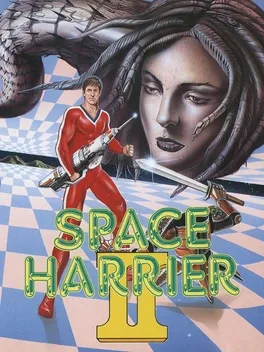
Space Harrier II
Introduction
When the Sega Mega Drive launched in 1988, it needed a title that could showcase the raw power of 16-bit processing, and Space Harrier II was the perfect candidate to lead that charge. As a direct sequel to Yu Suzuki’s 1985 arcade masterpiece, this game had the massive responsibility of bringing the high-octane, "into-the-screen" 3D shooting experience into the living room. It was one of the few launch titles available for the system in Japan and later became a foundational piece of the Genesis library in North America. Space Harrier II took everything players loved about the original—the surreal landscapes, the blistering speed, and the bizarre enemy designs—and refined them for a home console audience. Even decades later, it remains a vibrant example of Sega's golden age of arcade-style home gaming, inviting players to step back into the shoes of the galaxy’s most iconic cosmic hero.
Story & Setting
The narrative of Space Harrier II is a classic tale of interstellar heroism. The peaceful and surreal realm known as Fantasyland has fallen under a dark shadow. A desperate call for help echoes from the deepest reaches of the universe, reaching our protagonist, the legendary Space Harrier. Destructive forces of unknown origin have invaded this vibrant world, twisting its beauty into a chaotic battlefield. Equipped with his powerful under-arm laser cannon, the Harrier must descend into the fray to prevent Fantasyland from being blown into total oblivion. The setting is famously dreamlike, featuring checkerboard horizons that stretch into eternity and sky-scapes filled with floating islands and prehistoric ruins. It is a world where logic takes a backseat to pure, unadulterated imagination, and the stakes are nothing less than the survival of an entire dimension.
Gameplay
The core gameplay of Space Harrier II retains the frantic, fast-paced action of its predecessor while introducing several key enhancements. Viewed from a behind-the-back, pseudo-3D perspective, players must navigate the Harrier through twelve distinct stages. A revolutionary feature for its time was the ability to select the starting stage, allowing players to tackle the game’s challenges in any order they chose before facing the final thirteenth stage. As the Harrier flies or runs across the rapidly scrolling terrain, he must dodge a relentless barrage of projectiles and obstacles, such as stone pillars and alien flora. The laser cannon is the player’s primary tool, firing rapid-fire bursts to clear out waves of enemies. Each stage concludes with a massive boss encounter, ranging from the three-headed dragon Trimera to the sinister Medusa. The game demands high-level reflexes and pattern memorization, as the screen often becomes a kaleidoscope of enemies and hazards that move at breakneck speeds.
This game has appeared on several platforms over the years, spanning from original 16-bit hardware to modern digital storefronts and emulated collections. It is often referred to by alternative titles such as Space Harrier 2 or Space Harrier II Classic in various regions and digital re-releases.
Legacy
Space Harrier II holds a significant place in gaming history as a technical milestone for home consoles. While it lacked the specialized "Super Scaler" hardware found in Sega's arcades, it successfully mimicked the effect through clever programming, proving that the Mega Drive was a powerhouse in its own right. It paved the way for future 3D shooters and established the "rail shooter" as a viable genre for home gaming. The game’s influence can be seen in later titles like Star Fox and Panzer Dragoon. Furthermore, its iconic soundtrack, composed by Tokuhiko Uwabo, became a hallmark of early FM synthesis music, with its upbeat and driving themes becoming synonymous with the Sega brand. For many gamers, Space Harrier II was their first true taste of arcade-quality action at home, making it a beloved cult classic that continues to be celebrated in retro collections today.
Fun Facts
Despite being a sequel to one of Yu Suzuki's most famous creations, Suzuki himself was not directly involved in the development of Space Harrier II, as he was busy with other projects at the time. Interestingly, the game was developed simultaneously with the Mega Drive hardware itself, which is why it was ready as a day-one launch title. Another fascinating bit of trivia is that the game features a unique 'Dark Side' final stage that only becomes available once all previous twelve stages have been cleared. Additionally, the game’s box art in North America and Europe was vastly different from the Japanese original, often featuring a more realistic, albeit less surreal, interpretation of the Space Harrier character. In some later mobile versions, the game was rebranded as Space Harrier II Classic as part of the Sega Forever initiative.