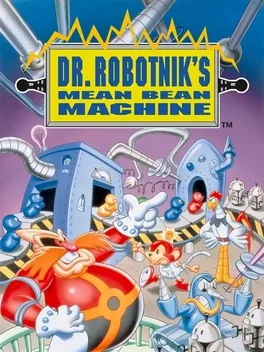
Dr. Robotnik's Mean Bean Machine
Introduction
In the early 1990s, the Sonic the Hedgehog franchise was expanding rapidly, branching out into cartoons, merchandise, and various spin-off titles. One of the most memorable entries from this era is Dr. Robotnik's Mean Bean Machine, a vibrant and addictive puzzle game that brought a unique twist to the series. Known by some as Dr. Robotnik and his Mean Bean Machine, the game served as a localized adaptation of the Japanese hit Puyo Puyo. By swapping out the original characters for the cast of the Adventures of Sonic the Hedgehog animated series, Sega created a product that appealed to Western audiences while introducing them to the deep, strategic mechanics of falling-block puzzles.
Story & Setting
The narrative of Dr. Robotnik's Mean Bean Machine takes place on Planet Mobius, the colorful home of Sonic and his friends. However, the focus here is not on the blue blur himself, but on the villainous Dr. Ivo Robotnik and the innocent citizens of Beanville. The diabolical doctor has hatched a plan to rid the planet of music, joy, and fun forever. To achieve this, he has deployed his "Mean Bean Steaming Machine," a device designed to transform the jolly folk of Beanville into devious little robots. These roboticized beans are destined to become part of his massive army, ensuring that no one on Mobius can ever have a good time again. Players take on the role of a hero tasked with grouping the beans together to help them escape Robotnik’s clutches and thwarting his mechanical ambitions before the "Mean Bean" transformation is complete.
Gameplay
The core gameplay of Dr. Robotnik's Mean Bean Machine is centered on classic falling-block puzzle mechanics. Players compete in a head-to-head format against a series of computer-controlled henchbots or a second player. As pairs of colored beans drop from the top of the screen, the goal is to arrange them so that four or more beans of the same color are touching. Once a group is formed, the beans "escape," disappearing from the board. The true depth of the game lies in its "chain reaction" system. By setting up the board so that one group of beans disappearing causes others to fall and form new groups, players can send "Refugee Beans" (also known as nuisance or garbage beans) to their opponent’s side. These gray beans act as obstacles, filling up the opponent's screen and preventing them from making moves until they are cleared by adjacent matches. The game features thirteen increasingly difficult stages, where players must face off against iconic henchbots like Arms, Frankly, Scratch, and Grounder, culminating in a final showdown with Dr. Robotnik himself.
This game was released on several platforms, including the Sega Mega Drive and the Wii.
Legacy
The legacy of Dr. Robotnik's Mean Bean Machine is significant for being many Western players' first introduction to the Puyo Puyo formula. While the original Japanese series would eventually find its own footing in the West years later, this Sonic-themed reskin paved the way for the genre's popularity. Over the decades, the game has been featured in numerous Sega compilations, such as the Sonic Mega Collection and Sega Genesis Classics, ensuring it remains accessible to modern gamers. Its influence even extends into modern Sonic titles; most notably, the "Chemical Plant Zone" boss fight in Sonic Mania is a direct homage to the gameplay of Mean Bean Machine, proving that its mechanics remain just as engaging and beloved today as they were in 1993.
Fun Facts
Despite being a Sonic spin-off, Sonic the Hedgehog does not actually appear as a playable character or even make a physical cameo in the game, focusing entirely on Robotnik's forces. In South Korea, the game is known by the alternative title 동글이 퇴치작전, which highlights the universal appeal of its circular characters. Additionally, while the game is famous for its difficulty, it utilized a password system that allowed players to jump back into their progress, a necessity for those struggling to beat the late-game AI. The character designs were pulled specifically from the Adventures of Sonic the Hedgehog cartoon, giving it a distinct visual style compared to the more "edgy" designs found in later Sonic games or the Saturday morning "SatAM" series.