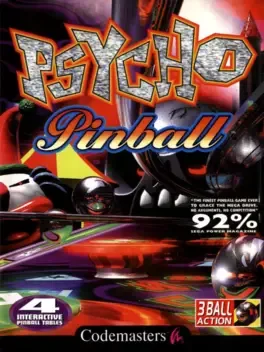
Psycho Pinball
Introduction
In the mid-1990s, the pinball genre on home consoles and PCs was undergoing a significant transformation. Developers were moving beyond simple physics simulations to create experiences that could only exist in a digital space. Among the most creative entries of this era was Psycho Pinball, a title published and developed by the British powerhouse Codemasters. Released in 1994, the game stood out in a crowded market by offering a high-energy, multi-table experience that successfully bridged the gap between realistic ball physics and the imaginative, "impossible" mechanics of video game arcade action. With its vibrant colors and frantic pace, Psycho Pinball quickly became a favorite for those seeking an alternative to the more stoic pinball simulators of the time.
Story & Setting
The setting of Psycho Pinball is less of a linear narrative and more of a thematic journey through a surreal, high-stakes amusement park. The game centers around its titular mascot, Psycho—a manic armadillo with a penchant for speed and chaos. The overarching theme is one of a twisted carnival, where each table represents a different "attraction." Players are not just playing pinball; they are navigating through distinct worlds, ranging from the depths of the ocean to the dusty trails of the American frontier. This thematic variety ensures that the game remains visually engaging, as each table has its own unique color palette, sound effects, and atmospheric music that helps to define the player's experience.
Gameplay
The core of Psycho Pinball is its unique table structure. The game features four distinct tables: Wild West, Trick or Treat, Abyss, and the central Psycho table. What set the game apart from its contemporaries was the "multi-table" mode. In this mode, the Psycho table acts as a central hub. By hitting specific targets and entering a designated "tent" or portal, players can actually transition from the Psycho table into one of the other three tables. This interconnectedness was a revolutionary concept for the time, providing a sense of scale and progression rarely seen in pinball titles.
Each table offers specific mini-games and challenges. The Wild West table features a shooting gallery where players must hit targets to gain bonuses, while Trick or Treat focuses on spooky hazards and Halloween-themed multipliers. Abyss takes the action underwater, requiring players to navigate sunken shipwrecks and sea life. The mechanics are fine-tuned to offer a fast-paced experience; the ball moves with incredible velocity, and the game rewards quick reflexes. Multiball modes, hidden bonus rounds, and high-score multipliers are packed into every corner, ensuring that there is always a goal to strive for beyond simply keeping the ball in play.
This game was released on several platforms, including the Sega Mega Drive and MS-DOS personal computers.
- SEGA MEGA DRIVE/GENESIS: PAL
Legacy
Psycho Pinball is frequently remembered as one of the best pinball games of the 16-bit era, particularly on the Sega Mega Drive. While it faced stiff competition from titles like Pinball Dreams and Devil's Crush, it carved out a niche for itself through its colorful presentation and Codemasters' signature polish. It demonstrated that pinball games didn't have to be rigid recreations of physical machines; they could be expansive, interconnected, and full of character. To this day, fans of the genre revisit the title for its smooth 60-frames-per-second performance (on console) and its challenging, imaginative table designs.
Fun Facts
- The mascot of the game, Psycho, is an armadillo, though his frenetic design often leads players to mistake him for other creatures.
- Psycho Pinball was one of the few games that allowed for an extensive 12-ball multiball, leading to absolute mayhem on the screen.
- Codemasters utilized their expertise in "squeezing" performance out of the Mega Drive hardware to ensure the game had minimal slowdown, despite the complex physics and fast-moving sprites.
- In the MS-DOS version, the graphics were even more detailed, though many purists prefer the Mega Drive version for its precise controller input and iconic FM synthesis soundtrack.