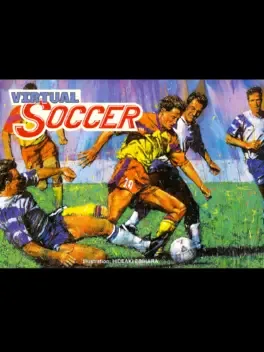
Virtual Soccer
Introduction
The 16-bit era was a transformative time for sports simulations, and in the early 1990s, the battle for the pitch was fought with pixels and passion. Among the contenders that emerged on the Super Nintendo was Virtual Soccer, a title that aimed to bring a more cinematic and customizable experience to fans of the beautiful game. Known in Japan as J-League Super Soccer, the game offered a blend of arcade accessibility and simulation-style depth that set it apart from its contemporaries. Whether you were looking for a quick friendly or a grueling international tournament, this title provided a robust platform for digital athletes to showcase their skills. Its arrival marked an era where developers began experimenting with more dynamic camera angles and deeper team management options, pushing the hardware of the time to its absolute limits.
Story & Setting
While most sports titles lack a traditional narrative, the "story" of Virtual Soccer is written by the player on the field. The game captures the high-stakes atmosphere of professional football during a time when the sport was seeing a massive global surge in popularity. In its Japanese incarnation, J-League Super Soccer, the game celebrated the newly established professional league in Japan, allowing fans to play as their local heroes. Internationally, the game shifted its focus to a broader stage, featuring a variety of national teams and fictionalized club structures. The setting is one of intense competition, where every match feels like a step toward immortality in the record books. The inclusion of various stadium atmospheres and weather conditions helps ground the experience, making each tournament feel like a distinct journey across the global footballing landscape.
Gameplay
The core of Virtual Soccer lies in its impressive array of perspectives and technical innovations. Unlike many soccer games of the time that locked players into a single viewpoint, this title offers a choice between a side view, a top-down view, or a unique 3/4 overhead perspective. This flexibility allowed players to choose the tactical layout that best suited their playstyle. Perhaps the most striking visual feature is the dynamic camera; the game utilizes the Super Nintendo's scaling capabilities to zoom in and out during pivotal moments, such as a long goal kick or a high-arching cross, adding a sense of scale and drama to the action.
Players can engage in several distinct modes of play. The Pre-season mode serves as a standard exhibition, while Custom Teams allows for a degree of personalization rarely seen in early console sports games. For those seeking long-term glory, the Continental Cup and Nations Shield provide structured tournament play, alongside a Custom Trophy mode for tailored competitions. For newcomers, a Practice mode is available to hone ball handling and shooting skills. Furthermore, the game provides extensive options to tweak the experience, including adjustable match lengths, varying weather conditions (from clear skies to rain), and the ability to change the game speed to match the player's reflexes.
This game was primarily released for the Super Nintendo Entertainment System, seeing distribution in both PAL and NTSC-U territories under its international title.
- SUPER NINTENDO ENTERTAINMENT SYSTEM: PAL, NTSC-U
Legacy
Virtual Soccer occupies an interesting place in gaming history. While it may not have reached the same level of enduring fame as the FIFA or International Superstar Soccer franchises, it is fondly remembered for its technical ambition. It was one of the titles that helped bridge the gap between simple 8-bit sports games and the complex, physics-based simulations of the 32-bit era. Its use of dynamic zooming was a precursor to the sophisticated camera systems found in modern sports titles. For many retro gaming enthusiasts, it remains a cult classic that represents the experimental spirit of the 1990s, offering a glimpse into how developers tried to make 2D sprites feel like a living, breathing 3D world.
Fun Facts
- The game’s Japanese title, J-League Super Soccer, features the official branding of the Japanese professional league, whereas the international version uses more generic branding to appeal to a wider audience.
- The dynamic zoom feature was often highlighted in marketing as a "Virtual" experience, which was a popular buzzword in the early 90s to denote advanced graphics.
- Despite being a 2D game, the different perspectives significantly change how the AI behaves, forcing players to adapt their strategies based on the selected camera angle.
- The ability to customize trophies was a forward-thinking feature that allowed players to create their own local neighborhood tournaments with friends.