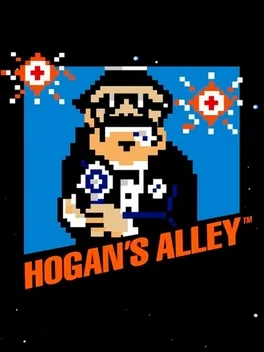
Hogan's Alley
Introduction
Hogan's Alley stands as a monumental pillar in the history of Nintendo’s early forays into home console gaming. Released in 1984, it helped define the capabilities of the Nintendo Entertainment System (NES) and its iconic Zapper peripheral. Long before the complex shooters of today, Hogan's Alley offered a primitive yet addictive test of reflexes and moral judgment. It was part of the "Programmable Series" and helped solidify Nintendo's reputation as an innovator in input technology. At its core, the game is a light gun shooter that prioritizes precision and speed, demanding that players think before they fire. As one of the first titles to utilize the light gun as a primary input device, it set the stage for a genre that would dominate arcades and living rooms for decades to come.
Story & Setting
The game takes its name and inspiration from a real-life tactical training facility. The original Hogan’s Alley was a specialized mock city built by the FBI Academy to train law enforcement officers in high-pressure urban environments. In the video game version, players are transported to a shooting range or a simulated city street. The atmosphere is that of a police training camp where the stakes are simulated, but the precision required is absolute. Instead of fighting sentient aliens or fantasy monsters, players face "cardboard cut-outs" that pop up or scroll across the screen. This grounding in reality gave the game a unique feel compared to other 8-bit titles of the era, focusing on the professional development of a marksman rather than a fantastical adventure.
Gameplay
Gameplay in Hogan’s Alley is categorized into three distinct modes, each testing a different aspect of the player's shooting ability. Game A, the namesake mode, places players in a training facility where three panels flip over simultaneously. The player must identify the villains and shoot them before they fire back, while avoiding the innocent civilians—namely a police officer, a refined lady, and a white-haired professor. Game B takes the action to a simulated city street where targets appear in windows and doorways. This mode requires faster reaction times and spatial awareness as the environment is more complex. Finally, Game C, known as "Trick Shot," challenges players to keep tin cans in the air by shooting them, bouncing them toward ledges for points. Across all modes, accuracy is key, as hitting a civilian or missing a villain results in a "miss." Accumulating three misses ends the session. In certain international contexts, the game is also known as Стрелбище, a name that emphasizes its nature as a pure shooting range experience.
This game was released on several platforms, including the original hardware in Japan and North America, as well as digital re-releases on newer systems.
Legacy
While it may be overshadowed by its contemporary, Duck Hunt, the legacy of Hogan's Alley is undeniable. It was a launch title for the NES in North America, serving as a crucial tech demo for the Zapper’s accuracy. Its focus on target discrimination—telling a friend from a foe in a split second—became a staple mechanic in future light gun titles like Lethal Enforcers and Virtua Cop. The characters from the game have also made cameo appearances in the Super Smash Bros. series, specifically as part of the Duck Hunt Duo's move set and as collectible trophies, ensuring that modern gamers still recognize these iconic cardboard cut-outs. It remains a nostalgic touchstone for those who grew up in the early years of the 8-bit revolution.
Fun Facts
Despite its simple appearance, Hogan's Alley utilizes a clever trick of light. When the Zapper's trigger is pulled, the screen flashes black for a single frame, and the targets become white boxes. The Zapper's photodiode detects this flash to determine if a hit was scored. Another interesting fact is that while the game is designed for the Zapper, certain arcade versions and modern emulations have adapted the controls for standard inputs. The name Hogan's Alley has become so synonymous with law enforcement training that the real FBI facility in Quantico, Virginia, still carries the name today. Furthermore, the game was part of the original lineup of titles available for the Nintendo VS. System, the company's dual-monitor arcade cabinet, which allowed two players to compete for high scores simultaneously.