Wild Gunman
Introduction
Story & Setting
Gameplay
Platforms
Legacy
Fun Facts
Introduction
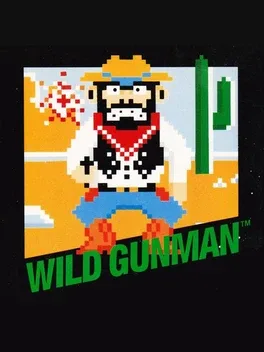
Wild Gunman is an iconic light gun shooter that represents a pivotal moment in Nintendo’s history as a pioneer of interactive home entertainment. Released during the golden era of the Nintendo Entertainment System (NES), this title was more than just a game; it was a demonstration of the NES Zapper’s potential to bring the excitement of the arcade directly into living rooms. Before Nintendo became a global powerhouse, they were experimenters in toys and arcade cabinets, and Wild Gunman reflects that transition perfectly. It captures the essence of the classic American Western, tasking players with testing their reflexes against some of the fastest-drawing outlaws in the pixelated West.
Story & Setting
The game is set in the rugged, lawless world of the Old West. While the narrative is minimal, as was typical for the era, the setting is evocative. Players step into the boots of a lone lawman or a quick-draw specialist tasked with cleaning up a town filled with notorious bandits. The game creates a sense of tension through its minimalist backdrops and silent standoffs. Interestingly, while known globally as Wild Gunman, the game was also recognized by the alternative name Дуел in certain markets, emphasizing the core duel mechanic that defines the experience. Whether standing in the middle of a deserted street or peering into the windows of a saloon, the atmosphere is unmistakably gritty, simplified by the charming 8-bit aesthetic of the mid-1980s.
Gameplay
The core gameplay of Wild Gunman revolves entirely around the NES Zapper. Players must wait for their opponent’s eyes to flash or for the visual cue "FIRE!" to appear on the screen before pulling the trigger. If the player shoots too early, it counts as a foul; if they shoot too late, they will find themselves staring at a "Game Over" screen as the outlaw gets the better of them.
The game features three distinct modes. Game A challenges the player against a single outlaw who appears in the center of the screen. As levels progress, the outlaws become faster and more unpredictable. Game B introduces a two-outlaw scenario, requiring the player to monitor both sides of the screen and react to whoever draws first. Finally, Game C, the Saloon mode, changes the perspective to a target-practice style. In this mode, outlaws appear in the windows and doors of a saloon, and the player must take them down before they can shoot. These mechanics emphasize hand-eye coordination and lightning-fast reflexes.
This game was released on several platforms, including the Nintendo Entertainment System, the original Family Computer in Japan, and later via digital distribution for more modern hardware like the Wii U.
Legacy
Wild Gunman holds a special place in gaming history, not just for its gameplay but for its cultural impact. Perhaps its most famous appearance outside of a Nintendo console is in the 1989 film Back to the Future Part II. In the movie, Marty McFly visits the "Cafe 80s" and shows two young boys how to play the game, only for them to dismiss it as a "baby's toy" because you have to use your hands. Historically, the game is significant because it originated as an arcade cabinet in 1974 that used 16mm film projection—a testament to Gunpei Yokoi’s ingenuity before the age of digital sprites. The NES version successfully distilled that complex setup into a cartridge that helped define the early library of the console.
Fun Facts
- The original 1974 arcade version used full-motion video of actual actors dressed as cowboys, which was quite advanced for its time.
- Many of the character designs in the NES version were reused or inspired designs in other early Nintendo titles, like Duck Hunt.
- Despite its simple premise, the game requires incredible precision; the timing window for some of the later enemies is just a fraction of a second.
- Gunpei Yokoi, the creator of the Game Boy, was instrumental in the development of the original arcade concept.