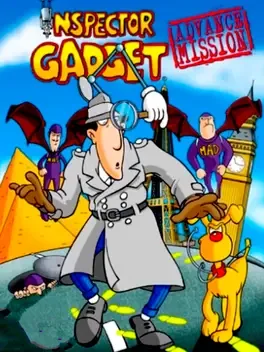
Inspector Gadget: Advance Mission
Introduction
Go-Go-Gadget-GBA! In 2001, the world’s most famous bumbling bionic detective made his way to the handheld screen in Inspector Gadget: Advance Mission. Developed by the French studio Magic Pockets and published by DreamCatcher Interactive, this title aimed to capture the charm, humor, and high-tech antics of the beloved 1980s animated series. Released during the early lifecycle of the Game Boy Advance, the game sought to provide fans with a portable experience that went beyond simple platforming, incorporating multiple playable characters and a variety of gadgets. As an action-adventure title, it challenged players to use their wits just as much as their reflexes to stop the nefarious forces of M.A.D.
Story & Setting
The narrative of Inspector Gadget: Advance Mission follows the classic structure of the original cartoon. The villainous Dr. Claw is once again hatching a scheme to take over the world using his secret organization, M.A.D. (Mean Agent Device). He has planted various devices and henchmen across the globe, threatening international security. Chief Quimby appears with his self-destructing messages to assign the case to the ever-optimistic, albeit clumsy, Inspector Gadget. The journey takes players through several distinct environments, from the icy peaks of the Himalayas to the high-tech corridors of secret M.A.D. bases. While Gadget believes he is the one solving the case, his niece Penny and her faithful dog Brain are working behind the scenes to ensure the mission is actually a success.
Gameplay
The core of Inspector Gadget: Advance Mission lies in its character-swapping mechanic. Players do not just control the Inspector; they must switch between Gadget, Penny, and Brain to navigate levels and solve puzzles. Each character possesses unique abilities essential for progression. Inspector Gadget is the primary combatant, utilizing his wide array of tools like the Gadget Mallet, the Gadget Copter, and spring-loaded shoes. However, Gadget is often limited by his own clumsiness.
Penny provides the technical support, using her computer book to hack into security systems and manipulate the environment. Brain, on the other hand, is the most agile character, capable of jumping high, performing stealthy maneuvers, and wearing disguises to sneak past M.A.D. agents. The levels are designed as elaborate puzzles where players must identify which character is best suited for the current obstacle. This "Advance Mission" requires a mix of platforming, light combat, and logic, mirroring the teamwork seen in the television show.
This game was released exclusively as a portable experience for Nintendo's 32-bit handheld system, bringing the animated world of Metro City to life in the palm of your hand.
Legacy
While Inspector Gadget: Advance Mission may not have redefined the platforming genre, it remains a nostalgic piece of software for those who grew up with the Game Boy Advance. It was praised at the time for its colorful sprites and faithful recreation of the cartoon's aesthetic. The developer, Magic Pockets, established themselves as specialists in licensed handheld titles, later working on franchises like Harry Potter and The Sims. For many fans, this game is remembered as one of the more competent adaptations of the Inspector Gadget license, successfully translating the show's multi-protagonist dynamic into a functional gameplay loop. It serves as a testament to the era of licensed handheld games where developers tried to pack as much variety as possible into a small cartridge.
Fun Facts
- The developer, Magic Pockets, is a French studio that became well-known for their technical proficiency on the Game Boy Advance hardware.
- Despite being an action game, many of the "boss fights" in the game are actually environmental puzzles that require the specific use of Gadget's tools.
- The game features the iconic theme music from the original 1983 television series, recomposed for the GBA's sound chip.
- Dr. Claw, as per tradition, is never fully seen in the game, maintaining the mystery of his true appearance that lasted throughout the entire original run of the cartoon.