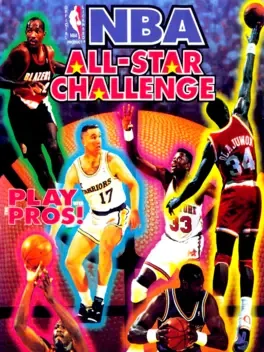
NBA All-Star Challenge
Introduction
In the early 1990s, the NBA was experiencing a global explosion in popularity, led by legendary figures who became household names across the world. Capitalizing on this fervor, developer Beam Software and publisher LJN Ltd. released NBA All-Star Challenge in 1991. Unlike many other basketball simulations of the era that focused on full five-on-five team play, this title took a different approach by focusing on the individual skill and star power of the league's elite players. It offered a concentrated experience of the NBA's annual All-Star Weekend, allowing fans to step into the sneakers of their favorite icons in high-stakes, skill-based competitions. Whether on a handheld or a home console, the game aimed to capture the competitive spirit of the hardwood.
Story & Setting
NBA All-Star Challenge does not feature a traditional narrative campaign; instead, its "story" is the quest for individual dominance within the professional basketball circuit. The setting is the prestigious NBA All-Star Weekend, a mid-season celebration where the best players in the league gather to showcase their talents. The game places players in various arena environments, from the bright lights of a televised three-point contest to the more intimate and intense setting of a half-court one-on-one duel. The atmosphere is designed to evoke the prestige of the NBA, featuring real-world players from the 1990-1991 season. The narrative drive comes from the player's own ambition to outshoot, outplay, and outmaneuver the greatest legends of the era to prove who truly deserves the title of All-Star.
Gameplay
The core of NBA All-Star Challenge is built around several distinct mini-games and skill challenges rather than full-court matches. The most prominent mode is the One-on-One, where players select a star and face off against an opponent in a half-court battle of dribbling, shooting, and defense. This mode emphasized the physical matchups that fans often debated in real life. Other key modes include the Free Throw Contest, which tested timing and precision, and the Three-Point Shootout, where players had to quickly find their rhythm to sink shots from beyond the arc before the timer expired.
Additionally, the game included a H-O-R-S-E mode, a playground classic that required players to mimic their opponent’s shots to avoid accumulating letters. The mechanics varied slightly between platforms, but generally involved a two-button control scheme: one for shooting or stealing and another for passing or rebounding. Defensive play was just as important as offense, requiring players to time their jumps for blocks and position themselves to strip the ball. The SNES and Genesis versions offered improved physics and player sprites compared to the monochrome Game Boy original, but all versions shared the same focus on individual mastery.
This game was released on several platforms, including the Game Boy, the Super Nintendo Entertainment System, and the Sega Mega Drive/Genesis.
Legacy
NBA All-Star Challenge occupies an interesting niche in the history of sports video games. While it was eventually overshadowed by the massive success of arcade-style hits like NBA Jam and the deep simulation of the NBA Live series, it remains a nostalgic touchstone for those who grew up in the early 16-bit era. It was one of the few titles of its time to prioritize the "superstar" aspect of the league over team-based play, a trend that would eventually become a staple of modern sports games through "Career" or "MyPlayer" modes. Despite the mixed reputation of its publisher, LJN, the game was generally seen as a solid sports title for the time, leading to the development of a sequel, NBA All-Star Challenge 2, which further refined the formula. Today, it is remembered as a charming artifact of a time when sports games were still experimenting with how to best translate the excitement of professional athletics to digital screens.
Fun Facts
- NBA All-Star Challenge was one of the few games of the early 90s to successfully license Michael Jordan’s likeness for some of its versions, as Jordan often had exclusive deals that kept him out of other major NBA titles.
- The game was developed by Beam Software, an Australian studio that eventually became Infogrames Melbourne House.
- While the Game Boy version was monochrome, it was praised for its surprisingly detailed player sprites considering the hardware limitations.
- The roster varied slightly between versions, but usually included heavy hitters like Patrick Ewing, Larry Bird, and Dominique Wilkins.