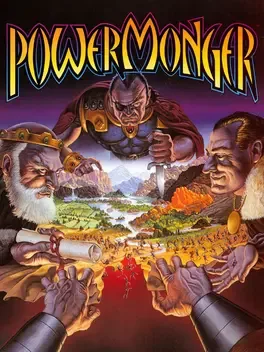
PowerMonger
Introduction
In the early 1990s, the landscape of strategy gaming was forever altered by Bullfrog Productions. Following the monumental success of Populous, the studio released PowerMonger (often also written as Power Monger), a title that refined the "god game" genre into something more grounded, tactical, and simulation-heavy. While Populous gave players the powers of a deity, PowerMonger places them in the boots of a deposed captain seeking to reclaim lost glory. It is a game of logistics, conquest, and management, set within a sophisticated living world that was far ahead of its time.
Story & Setting
The world of PowerMonger is a fractured one. In a land without kings, power is the only law that holds any weight. The narrative is driven by a power vacuum; no single leader controls the destiny of this new world, leaving it ripe for a conqueror to step forward. Players take on the role of a general who has been forced out of his own kingdom and must now navigate 195 different territories to rebuild an empire.
This is not a static map but a living world. Every territory is populated by hundreds of individuals with their own lives. You will encounter farmers, shepherds, merchants, and ranchers, all of whom have individual homes and daily routines. Even the thieves and outcasts play a role in this ecosystem. Your task is to unite these disparate people—either through the silver tongue of diplomacy or the sharp edge of a sword—to forge a new destiny for the realm.
Gameplay
PowerMonger is a real-time strategy game that emphasizes the "living world" aspect of its simulation. Unlike modern RTS games that focus on rapid unit production, this game focuses on the management of existing populations and resources. To win, you must conquer enough of a map’s population to move on to the next territory. This can be achieved through total military annihilation or by convincing the local leaders to join your cause.
One of the most innovative features is the seasonal system. Players must constantly react to changing seasons. In this world, soldiers cannot survive on ambition alone; they require sustenance. Storing food for the winter is a vital mechanic, as your soldiers won't take orders on an empty stomach. The game also features a functional inventory system where units can pick up tools, weapons, and food, adding a layer of logistical depth. Whether you are ordering a blacksmith to forge swords or commanding your troops to hunt for provisions, every action ripples through the local economy and morale.
This game was released on several platforms, including the Atari ST, Sega Genesis, and various other home consoles and computers of the era.
Legacy
PowerMonger is remembered as a technical marvel for the early 90s. Its 3D engine allowed for a rotatable, zoomable map, which provided a level of tactical perspective that was rare at the time. While it never reached the same level of pop-culture ubiquity as Populous, it is highly regarded by strategy enthusiasts for its depth and its more mature, gritty approach to conquest. Many of the AI concepts and simulation elements seen here paved the way for Bullfrog’s later hits, such as Syndicate and Dungeon Keeper. It remains a testament to Peter Molyneux's early era of innovative, systems-driven design.
Fun Facts
- The game’s AI was remarkably advanced for 1990; every NPC has a "personality" that dictates how they react to the player's presence.
- The original PC and Atari versions used a unique copy protection system involving a physical code wheel.
- There was an expansion pack titled PowerMonger: World War I Edition, which swapped the medieval setting for the trenches and biplanes of 1914.
- The game tracks every single item in the world; if a soldier drops a piece of food in a forest, it stays there until someone else finds it.