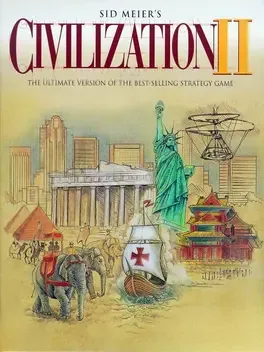
Sid Meier's Civilization II
Introduction
Released in 1996, Sid Meier's Civilization II stands as a monumental achievement in the turn-based strategy genre. Often abbreviated as Civ 2 or Civ2, this title expanded upon the foundation of its predecessor to create a deep, addictive, and infinitely replayable experience. Whether you knew it as Sid Meier's Civilization 2 or simply Civilization 2, it was the game that defined the "one more turn" syndrome for an entire generation. It moved the series into the isometric era, offering a level of complexity and polish that set a new benchmark for the 4X subgenre. To this day, it remains a favorite among strategy enthusiasts for its perfect balance of historical scope and deep strategic management.
Story & Setting
Unlike traditional narrative-driven games, the story of Sid Meier's Civilization II is the history of humanity itself. Players begin their journey in 4000 BC with a single settler unit and a dream of empire. From these humble beginnings, you must guide your chosen civilization through the ages, navigating the perils of the Bronze Age, the intellectual enlightenment of the Renaissance, and the industrial might of the modern era. The setting spans the entire globe, offering players the chance to rewrite history and see how different cultures might have flourished under different leadership. Whether leading the Romans, the Egyptians, or the Americans, the ultimate goal is to "stand the test of time." This is achieved either through world conquest—unifying the globe under one flag—or by being the first to reach the stars by colonizing Alpha Centauri.
Gameplay
The core gameplay of Civilization II revolves around the four "X" pillars: eXplore, eXpand, eXploit, and eXterminate. One of the most significant changes from the original game was the shift to an isometric perspective, which gave the world a sense of depth and visual flair. Players manage city growth, build vital infrastructure, and research a massive technology tree. From the early discovery of the wheel to the world-altering power of nuclear fission, every technological breakthrough impacts your empire's trajectory.
The diplomatic system in Civ 2 was significantly refined compared to its predecessor, allowing for more complex interactions with AI-controlled world leaders. Players can form alliances, trade technologies, or demand tribute from weaker neighbors. Furthermore, the introduction of "Wonders of the World" provided massive strategic advantages. Building the Great Library or the Statue of Liberty offered unique bonuses that could pivot the entire geopolitical landscape. Managing your citizens' happiness, balancing taxes versus science funding, and positioning military units strategically are all essential to surviving the rise and fall of rival nations.
This game was released on several platforms, including Windows, Macintosh, and the PlayStation.
Legacy
The legacy of Civilization 2 is immense. It is frequently cited in lists of the greatest video games of all time. Its modding community was one of the earliest and most active in the industry, leading to thousands of user-created scenarios that kept the game relevant for decades after its release. Perhaps the most famous testament to its depth is the "Eternal War" story, where a player continued a single game for over ten years, resulting in a dystopian, post-apocalyptic stalemate that captured the internet's imagination and even caught the attention of Sid Meier himself. It solidified the franchise as the gold standard for strategy games and paved the way for the future of the 4X genre.
Fun Facts
- The game featured live-action video sequences for the "High Council." Actors in period-appropriate costumes gave advice (or argued) based on your progress.
- If your civilization enters the modern era and focuses on luxuries, the Luxury Advisor is replaced by an Elvis Presley impersonator.
- Civilization II was the first in the series to include a dedicated scenario editor, allowing players to create their own historical "what-if" situations.
- Unlike later games in the series, Civ2 used a system of hit points and firepower for combat, which made it possible (though rare) for a phalanx to occasionally defeat a tank.