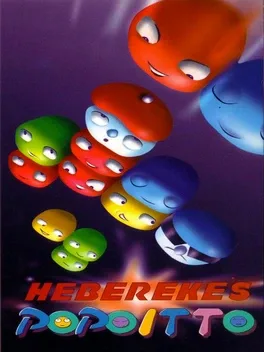
Hebereke's Popoitto
Introduction
In the mid-1990s, the puzzle genre was experiencing a significant boom, fueled by the success of titles like Tetris and Puyo Puyo. Amidst this competitive landscape, Sunsoft decided to bring its quirky mascot series back to the forefront with Hebereke's Popoitto. Known in some circles as Hebereke Station Popoitto, this title offers a refreshing, character-driven twist on the falling-block formula. While it may look like a standard tile-matching game at first glance, its unique mechanics and surreal charm ensure it stands out as a cult classic of the 16-bit and 32-bit eras. Whether you are a fan of the original Ufouria: The Saga or a puzzle enthusiast looking for a challenge, this game provides a colorful and chaotic experience.
Story & Setting
The game takes place in the whimsical and often bizarre world of Hebereke, inhabited by a cast of surreal creatures. The protagonist is Hebereke, a small blue penguin with a penchant for adventure and a slightly cynical attitude. The narrative follows Hebereke as he decides to participate in a grand tournament. This isn't just a friendly gathering; Hebereke is determined to prove his skills against his wide array of friends and rivals, including the ghost-like Sukezaemon, the cat-girl O-Chan, and the anglerfish Jennifer.
The setting is vibrant and filled with the signature Sunsoft humor that fans of the franchise have come to adore. Each stage of the tournament represents a different character's territory, bringing the diverse world of the Hebereke series to life through beautifully animated backgrounds and expressive character sprites.
Gameplay
At its core, Hebereke's Popoitto is a falling-block puzzle game that emphasizes speed and tactical positioning. Like many variants of the genre, the basic loop involves pieces falling from the top of the screen which the player must rotate and steer. When four or more blocks of the same color are aligned vertically, horizontally, or in a cluster, they vanish from the board.
However, the true innovation of this variant lies in its objective-based clearing system. Unlike standard Tetris, where the goal is to clear lines, the primary objective here is to eliminate specific "enemy" blocks that are already present on the playfield. These blocks represent characters from the franchise and serve as the targets for each level. To make matters more difficult, these target blocks are not static; they frequently move across the playfield, forcing the player to adapt their strategy on the fly. You cannot simply build a structure and wait; you must actively hunt the moving targets while managing the rising stack of falling pieces.
In the competitive versus mode, clearing large chains of blocks sends "garbage" pieces to the opponent's screen, a staple of the genre that keeps matches intense. The combination of moving targets and traditional chain-building creates a frantic pace that rewards both foresight and quick reflexes.
This game was released on several platforms, including the PlayStation, the Sega Saturn, and the Super Nintendo Entertainment System.
Legacy
Hebereke's Popoitto remains a cherished entry in Sunsoft's history, particularly for European and Japanese gamers. In Europe, the series gained a dedicated following under the Hebereke and Ufouria brandings, and this puzzle entry was often praised for its high-quality music and distinct visual style. While it never achieved the global mainstream recognition of Tetris, it helped cement the Hebereke characters as beloved mascots of the 90s.
The game is also remembered for being part of a larger trend where developers experimented with "action-puzzle" mechanics. By introducing moving elements into a stationary grid, Sunsoft paved the way for more dynamic puzzle designs. Today, collectors often seek out the Saturn and PlayStation versions for their crisp 2D art and improved sound fidelity compared to the SNES original.
Fun Facts
- The word "Popoitto" in the title is a Japanese onomatopoeia often used to describe the act of casually throwing something away or discarding it.
- While the SNES version is a beloved classic, the 32-bit versions (PlayStation and Saturn) feature significantly enhanced audio tracks and more fluid character animations.
- In North America, the Hebereke series is most famous for its debut title Ufouria: The Saga, but Popoitto was one of the few sequels to make it to the European market during the 90s.
- Each character in the game has a unique "Special Attack" in certain modes, which can disrupt the opponent's board in various annoying and hilarious ways.