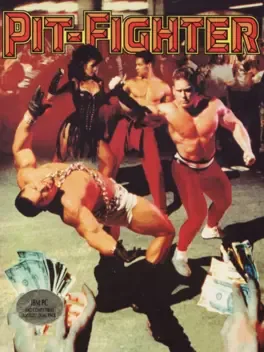
Pit-Fighter
Introduction
Long before the ultra-violent spectacles of the mid-90s took over the arcade scene, Atari Games released a gritty, digitized brawler that sought to redefine the fighting genre. Released in 1990, Pit-Fighter (also commonly known as Pit Fighter) was a pioneer in using digitized actors instead of hand-drawn sprites, giving the game a photorealistic look that was jarring and revolutionary for its time. Stepping away from the traditional martial arts tournaments of its contemporaries, it immersed players in the raw, unpolished world of underground fighting pits, where the only rule was survival and the crowd was just as dangerous as the opponent.
Story & Setting
The narrative of Pit-Fighter is simple yet effective, focusing on the brutal world of illegal prize fighting. There are no magical orbs or world-ending threats here; instead, players take on the roles of three distinct combatants looking to prove their dominance in the pits. As they progress through fifteen increasingly difficult matches, they are constantly taunted by a mysterious entity known as the Masked Warrior. This shadowy figure serves as the ultimate goal for every fighter, representing the pinnacle of the underground circuit. The setting is intentionally claustrophobic, often taking place in dark alleys or dingy bars where the audience stands inches away from the action, frequently blurring the line between spectator and participant.
Gameplay
The core gameplay of Pit-Fighter draws inspiration from titles like Taito's Violence Fight and SNK's Street Smart, emphasizing a more open-area movement style than the 2D plane of Street Fighter. Players select from three heroes: Buzz, a powerful wrestler; Ty, an agile kickboxer; and Kato, a fast third-degree black belt. Each character possesses unique stats for speed, power, and specific move sets. The controls are intuitive, featuring jump, punch, and kick buttons. However, the real depth comes from the "super move," executed by pressing all three buttons simultaneously, allowing each fighter to unleash a devastating signature attack.
Progression is marked by 15 different matches. Every third fight introduces a "Grudge Match," a bonus round where players must face a CPU-controlled clone of themselves or, in multiplayer modes, fight their fellow players. Getting knocked down three times results in elimination from the Grudge Match, though the winner walks away with a significant cash bonus.
Interactivity is a hallmark of the experience. The arenas are littered with foreign objects like knives, crates, bar stools, and even motorcycles that can be weaponized. Occasionally, a "power pill" will appear, granting temporary invulnerability and increased strength. Furthermore, the crowd is actively involved. Figures like Knife Man (Milt Loper) and Knife Woman (Dianne Bertucci) will occasionally step out to stab the players, while a bearded man with a stick can be disarmed to gain a weapon. If a player lingers too long at the edge of the screen, the audience will physically push them back into the fray.
This game was released on several platforms, including the Atari Lynx, Commodore 64, and major 16-bit consoles like the Sega Genesis and Super Nintendo.
Legacy
Pit-Fighter occupies a unique space in gaming history. While its digitized graphics were eventually surpassed by the Mortal Kombat series, it was one of the first major titles to prove that real-life actors could be successfully integrated into a digital environment. In the arcades, it was a massive success, praised for its three-player cooperative play—a rarity for fighting games at the time. Although home console ports struggled to replicate the arcade's visual fidelity, the game remains a cult classic, remembered for its gritty atmosphere and the chaotic, interactive nature of its combat.
Fun Facts
- In the original arcade version, player positions were color-coded for clarity: Player 1 was Blue, Player 2 was Red, and Player 3 was Yellow.
- The digitized actors were actually Atari employees and local talent; for instance, the crowd nuisances Knife Man and Knife Woman were played by Milt Loper and Dianne Bertucci respectively.
- The final "Championship Match" against the Masked Warrior features a unique twist: if multiple players are still active, they must first fight each other to the death, with only the lone survivor earning the right to face the final boss.