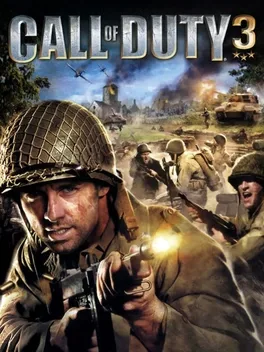
Call of Duty 3
Introduction
Released in 2006, Call of Duty 3 marked a significant evolution for the legendary first-person shooter franchise. Developed by Treyarch and published by Activision, it was the first major entry in the series to focus exclusively on the console market, bypassing a PC release at launch. Often referred to by fans as CoD3, this title aimed to deliver a more cinematic and technically ambitious representation of World War II than its predecessors. By utilizing the power of seventh-generation hardware, the developers were able to create an immersive battlefield that emphasized the scale and brutality of the Allied push through Europe. This installment solidified the franchise's transition into a multi-developer powerhouse, proving that the series could maintain its high standards while expanding its narrative reach.
Story & Setting
The narrative of Call of Duty 3 is deeply rooted in historical accuracy, specifically focusing on the Normandy breakout. This pivotal period followed the initial D-Day landings and involved the intense Allied offensive to drive German forces out of northern France and liberate Paris. This focus is highlighted in the alternative title, Call of Duty 3: En marche vers Paris. Rather than following a single protagonist, the game features an ensemble cast representing four different Allied nations: the United States, Great Britain, Canada, and Poland. Players experience the conflict through the eyes of paratroopers, infantrymen, and tank commanders, showcasing the diverse international cooperation required to collapse the Nazi front. This multi-perspective storytelling provides a broader view of the war’s complexity and the shared heroism of the Allied forces, moving from the hedgerows of Normandy to the high-stakes tank battles in the Polish campaign.
Gameplay
In terms of mechanics, Call of Duty 3 introduced several features that pushed the boundaries of the genre at the time. The gameplay is famously intense and fast-paced, with a greater emphasis on scripted events that simulate the chaotic nature of frontline combat. A major addition was the close-quarters battle system, which triggered quick-time events where players had to physically struggle with enemy soldiers in hand-to-hand combat. The game also refined the series' shooting mechanics and introduced interactive tasks like rowing boats, planting explosives, or turning valves. Multiplayer was also a significant draw, supporting large-scale battles with up to 24 players on next-gen consoles. It featured a class-based system and the integration of vehicles, such as tanks and motorcycles, allowing for tactical, squad-based gameplay that would become a staple of the franchise's later success.
Call of Duty 3 was released across multiple home consoles, spanning two generations of gaming hardware, ensuring that players on various systems could experience the liberation of France.
Legacy
The legacy of Call of Duty 3 is most notable for establishing Treyarch as a premier developer in the series. While Infinity Ward had created the franchise, Treyarch proved they could deliver a high-quality, high-stakes sequel under immense time pressure. Although some fans were disappointed by the lack of a PC port, the game was a commercial hit and received praise for its sound design, realistic physics, and immersive atmosphere. It successfully bridged the gap between the older console generation and the new power of the Xbox 360 and PlayStation 3. Today, it is remembered as the entry that cemented the alternating development cycle of the franchise and paved the way for Treyarch's future iconic sub-series like Black Ops, which would eventually dominate the first-person shooter market for years to come.
Fun Facts
Interestingly, Call of Duty 3 is the only main-series entry not to receive a PC release. The Wii version of the game was unique for its motion-sensing gameplay, where players would use the Wii Remote to mimic physical actions like swinging a rifle to perform a melee attack or pulling a grenade pin. Another fascinating detail is the inclusion of the Polish 1st Armored Division, which offered a rare look into Poland's significant but often underrepresented contribution to the liberation of France during the Battle of Falaise. Additionally, the game's sound design was highly lauded at the time, utilizing field-recorded audio to ensure that every explosion and engine roar sounded as authentic as possible.